
You open your front door and see a patch of water on the threshold. You stop before stepping over it. You might not have given it more than a moment, had it not been for a video you watched yesterday about "signs of sprinkled magic." You look at the wet patch again, then at your neighbours' doors.
The water has not changed between the two glances. What has changed is the question: a moment ago, you wanted to know who had spilled it; now you are looking for someone who meant to harm you.
Water or an unknown substance outside your front door is not, by itself, enough to establish sprinkled sihr or identify someone to accuse of it. You can describe what you have found, investigate its source and take precautions around an unknown substance before drawing a firm conclusion about what it is.
What Is Meant by Sprinkled Sihr?
Some fatwa websites use this term for magic placed in a liquid and then sprinkled where a person lives or passes. This defines how the term is used; it is not the result of testing water found outside a particular door. For example, it appears in this sense in Islam Question & Answer, answer no. 326488. [1]
The distinction matters. You may know what people mean by a term without knowing whether it applies to what is in front of you. Calling it "suspicious water" describes your uncertainty; calling it "magic" adds a judgment that has not yet been established.
So do not begin with a checklist that assigns signs of magic to the colours of liquids or the times at which they are found. Begin with the nearer question: what did you actually find? Do you know that it is water, or is it a liquid you have not identified?
What Does Islam Say, and What Still Requires Evidence?
The Qur'an mentions magic in the words "teaching people magic," and says in the same verse: "Yet they do not harm anyone through it except by God's permission" [Al-Baqarah 2:102]. But the verse does not provide a test for judging an unidentified patch by its colour or smell. Something being affirmed in scripture does not remove the need for verification when we attribute it to a particular event. [2]
Another principle accompanies this question: "Do not pursue what you have no knowledge of" [Al-Isra' 17:36]. When we do not know the source of a liquid, that is the present limit of our knowledge. We can extend it by asking questions and investigating; we do not have to fill the gap with the most frightening possibility. [3]
Suspicion that prompts you to take precautions also differs from an accusation that affects another person. God says: "Avoid much suspicion; indeed, some suspicion is sin" [Al-Hujurat 49:12]. In his commentary, Ibn Kathir discusses the prohibition on unfounded accusations and distrust towards family, relatives and other people. A past disagreement with a neighbour does not become evidence that they put something outside your door. [4]
Are a Liquid's Colour or Its Repeated Appearance Signs of Sprinkled Sihr?
Details help describe what happened and may help a specialist identify a substance or the source of a leak. But looking at them does not, by itself, reveal the intentions of whoever put the substance there, or establish a supernatural effect attributed to it.
Suppose a recording shows someone pouring a liquid outside the door. You now have evidence of a specific act, which you can ask about or report according to the circumstances. The recording alone, however, does not identify the liquid's composition or establish the effect attributed to it. The strength of evidence depends on what it actually shows, not everything we fear after watching it.
If the wet patch keeps appearing, investigating its source becomes more useful. Does it appear after the entrance has been cleaned? Does it extend from a pipe or a damp area? Have other people noticed it? These questions help gather evidence; we do not assume their answers in advance, even when one possibility feels more reassuring.
Why Might Symptoms Begin After You Discover the Water?
Someone may say, "I felt nothing before, but then I saw the water and developed a headache." That account deserves to be taken seriously, but it does not settle the cause. The sequence of the two events alone cannot distinguish between exposure to a harmful substance, the effects of fear and expectation, or another cause that happened to coincide with them.
Research on the effects of negative expectations, known as the nocebo effect, helps us understand one of these possibilities. In an experiment published by Michael Witthöft and James Rubin in 2013, 147 participants were randomly assigned to watch either a television report warning about the effects of Wi-Fi or a control film, then underwent a sham exposure to a Wi-Fi signal. The main outcome measure was the symptoms they reported afterwards. [5]
The alarming report increased concerns about electromagnetic fields and increased symptom reporting after the sham exposure among participants with high pre-existing anxiety. This does not mean that everyone who watches a warning will develop symptoms, or that every episode of feeling unwell after a fright has a psychological cause.
By comparison, a study published by Christoph Boehmert and colleagues in 2018, with a final sample of 137 participants, did not find the predicted effect of precautionary information on symptoms during sham exposure to a wireless network. This finding prevents us from reducing the matter to "any warning creates illness." The form of the information, its context and its recipient all require examination. [6]
Neither study tested magic or liquids found at entrances. We use them to understand the limits of inferring a cause from symptoms appearing after an expectation of harm. They cannot be used to decide that a particular person is imagining things, or to rule out a harmful substance without investigation.
The Trail of Water in Umm Abbas: When a Household Disagrees About What It Sees
In chapter three of my novel Umm Abbas: Bringing the Beloved and Reuniting a Divorced Woman with Her Husband, Maryam wakes to a sound, then finds a wet trail outside the bathroom door. It extends towards her room and stops at her door. She says she did not come from the bathroom, and her father asks whether she has spilled anything. After looking inside the bathroom, he calls what he has seen a leak; Maryam finds no reassurance in the word. [7]
What makes the scene affecting is that the family sees the same trace but brings different questions to it. The father wants an explanation he can act on; the mother is afraid; and Maryam is exhausted by being questioned in a way that feels like an accusation. The disagreement is no longer about the water alone. It has become a question of who is believed and how fear is heard.
In the scene's construction, the trail of water narrows the distance between the bathroom and Maryam's room, while widening the distance between members of the family. This is what literature makes possible: it lets us feel the weight of a question before it is settled. The scene's significance remains literary; we cannot move from it to diagnosing a household or explaining an event outside the novel.
The most useful words in a frightened home may be simple: we saw a wet patch, and we do not yet know where it came from. We will try to understand it, and we will take your fear seriously while we do. These words give the place a chance to be examined, and the person a chance to speak.
What Should You Do If You Find an Unknown Substance Outside Your Door?
Begin by protecting safety. Keep children and animals away from the substance, and avoid touching it directly, tasting it or deliberately breathing it in. If it is known to be ordinary cleaning water or a harmless leak, the cause can be dealt with in the usual way. But when you have not identified a substance, do not assume that pouring a cleaning product over it will make it safe.
The Centers for Disease Control and Prevention warn against mixing bleach or disinfectants with other cleaning products because this may release dangerous vapours. So do not experiment with household mixtures to get rid of an unknown liquid, and do not burn a substance you have not identified. [8]
You can photograph its location from a safe distance, record when you found it, and ask the building management or whoever is responsible for the premises about a leak or cleaning. If a substance is repeatedly placed there deliberately, or this is accompanied by a threat, seek help from the appropriate authority where you live, describing precisely what you have documented.
If you think someone has been exposed to a harmful substance by swallowing, touching or inhaling it, seek urgent medical advice. Severe breathing difficulty or loss of consciousness calls for local emergency services. Health guidance stresses that you should not wait for symptoms to appear when poisoning is suspected; some symptoms may be delayed. [9]
Can I Recite the Qur'an and Perform Ruqyah?
In Sahih Muslim, 'Awf ibn Malik al-Ashja'i, may God be pleased with him, narrates the Prophet's words, may God bless him and grant him peace: "There is no harm in incantations as long as they contain no polytheism." The hadith is authentic and is included by Muslim in his Sahih. You can seek reassurance in your worship and lawful ruqyah while continuing to investigate the substance's source and seek whatever help is needed. [10]
But feeling better after recitation is not, on its own, enough to identify what was on the threshold. Nor must you keep searching every corner until you reach complete certainty. If fear persists and begins to restrict your sleep, your ability to go out or your relationships, describe its effects and seek qualified help, rather than remaining alone with multiplying interpretations.
When seeking help, pay attention to the answer you receive. Does the person explain what they relied on and welcome questions, or begin by naming an unknown perpetrator and asking you to believe them? Confidence in someone's tone does not supply evidence for their accusation.
You may find the source of the wet patch, or you may need someone to help you identify it. In the meantime, you can preserve the distinction between three statements: "I saw a trace," "I was afraid of it" and "I learned its cause." Each requires its own evidence; none can take the place of another.
The following night, when someone opens the door, it is enough to find the household ready to ask calmly: what happened? An answer remaining incomplete for a while is easier to bear than an accusation made complete without evidence. The threshold of a home has a simpler, lovelier purpose than carrying all this: to let us cross towards those we love and find somewhere to rest.
Sources and References
- Islam Question & Answer, 326488. "Sprinkled Magic," 11 January 2024. Used to explain the term as it appears in the fatwa, not to diagnose a particular trace. Text.
- The Qur'an, Al-Baqarah 2:102. The verse.
- The Qur'an, Al-Isra' 17:36. The verse.
- The Qur'an, Al-Hujurat 49:12; Ibn Kathir's commentary. The verse and commentary.
- Michael Witthöft & G. James Rubin, 2013. Are media warnings about the adverse health effects of modern life self-fulfilling? An experimental study on idiopathic environmental intolerance attributed to electromagnetic fields (IEI-EMF). Journal of Psychosomatic Research, 74(3):206-212. DOI: 10.1016/j.jpsychores.2012.12.002. Abstract and publication details.
- Christoph Boehmert, Adam Verrender, Mario Pauli & Peter Wiedemann, 2018. Does precautionary information about electromagnetic fields trigger nocebo responses? An experimental risk communication study. Environmental Health, 17:36. DOI: 10.1186/s12940-018-0377-y. The study. The relevant findings and limitations are presented; neither study claims to have tested magic.
- Ahmed Alhafiz. Umm Abbas: Bringing the Beloved and Reuniting a Divorced Woman with Her Husband. Chapter three, "The House That Did Not Believe," pp. 60-62 of the author's supplied 324-page file. Page numbers refer to that copy; this is a literary reference. The novel's page.
- CDC. Cleaning and Disinfecting with Bleach. Warning against mixing cleaning products and disinfectants. Official source.
- NHS. Poisoning. Latest displayed review: 12 June 2025. Guidance on suspected exposure to a harmful substance; UK service numbers are not applied to other countries. Official source.
- Sahih Muslim, 2200. 'Awf ibn Malik al-Ashja'i's hadith on ruqyah free of polytheism. Text and reference.
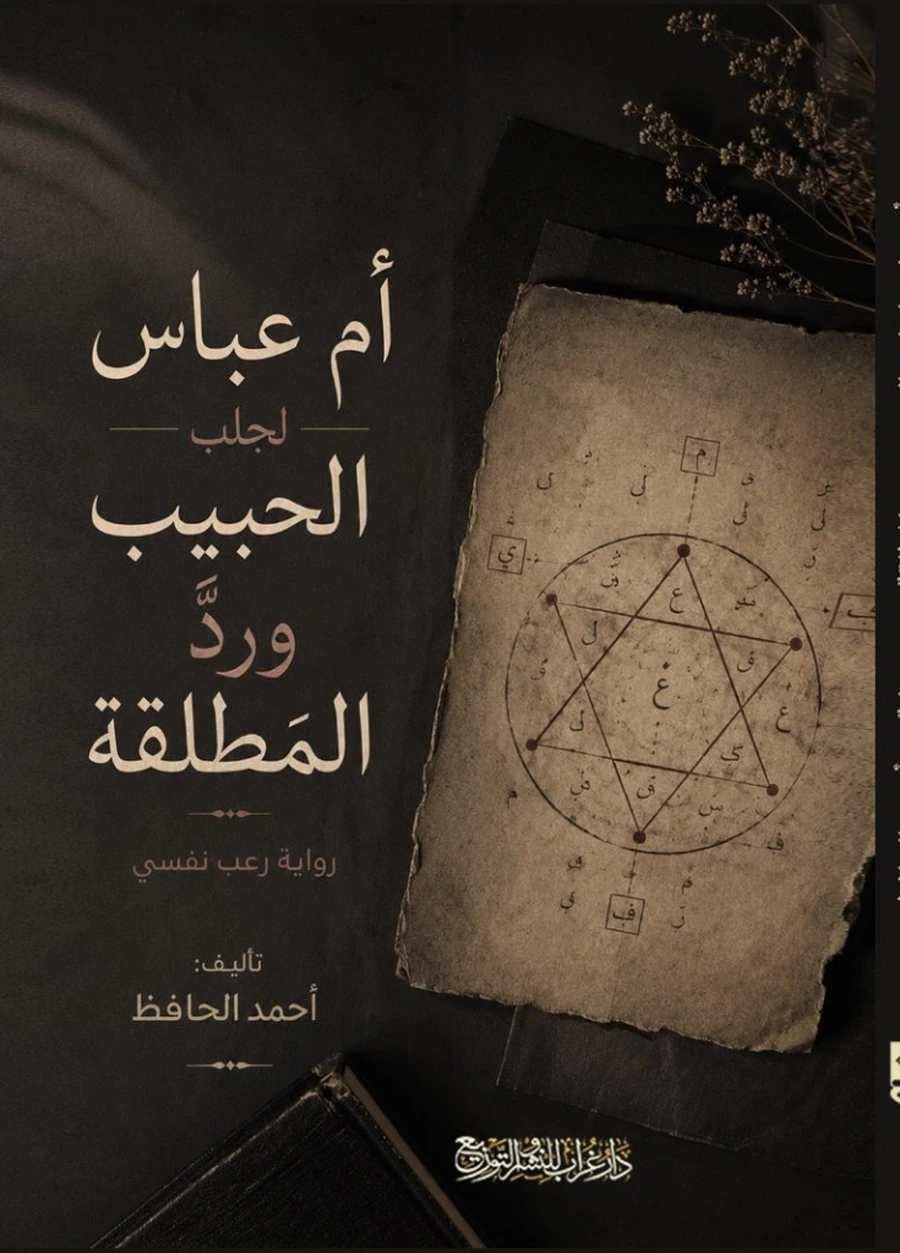
Umm Abbas: Bringing the Beloved and Reuniting a Divorced Woman with Her Husband
A forthcoming psychological horror novel by Ahmed Alhafiz. The trail of water in Maryam's home, and the distance between seeing a trace and interpreting it.
Explore the novelAlhafiz, Ahmed. "Signs of Sprinkled Magic: Is Water at the Door Evidence?" 27 October 2026. https://ahmedalhafiz.com/articles/sprinkled-magic-water-door-evidence/