
Author, link, and structural review is complete. No independent specialist in water governance, irrigation archaeology, ancient South Arabia, or Qur’anic studies has reviewed this version. It is not peer-reviewed scholarship, and every conclusion remains correctable.
How should this ledger be read?
Confidence is not certainty. “High” means that the claim type is supported by several appropriate lines of evidence; “medium–high” means that the synthesis relies more heavily on comparison or interpretation. Every claim links directly to sources below. The forthcoming book is a thematic origin, not evidentiary support.
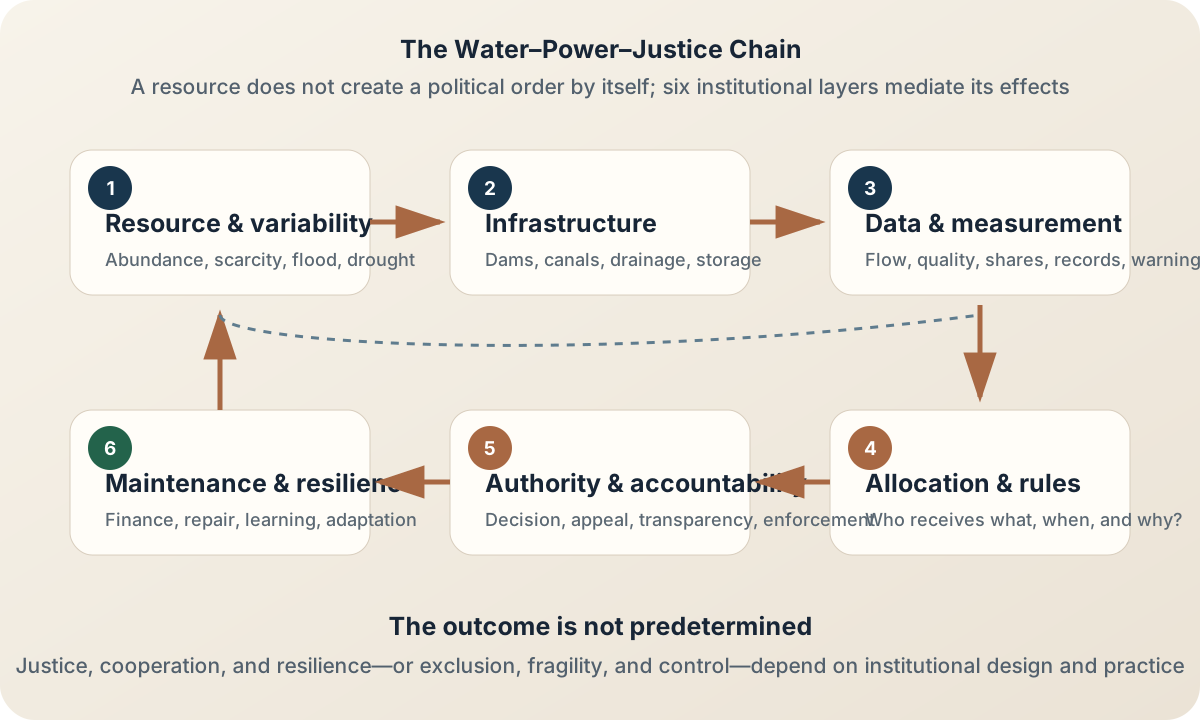
The six analytical layers
Resource and variability → infrastructure → data and measurement → allocation and rules → authority and accountability → maintenance and resilience. No layer mechanically determines political form; outcomes depend on their interaction.
Complete claim ledger
| ID | Claim | Confidence | Sources | Limits | What could change it? |
|---|---|---|---|---|---|
| C01 | Water availability is an important condition for settlement and production, but it does not create civilisation or the state by itself; institutions mediate its political effects through knowledge, infrastructure, allocation, and accountability. | High | R05, R08, R12, R13, R14, R15, R21 | This is a synthesis, not a monocausal historical law. Outcomes vary with ecology, technology, system scale, property relations, and political organisation. | The conclusion would weaken if broad comparative evidence showed water abundance or scarcity alone predicting political form regardless of institutions. |
| C02 | A water system is not merely a dam or canal; it is a continuing cycle of measurement, finance, operation, maintenance, allocation, dispute resolution, and monitoring. | High | R05, R10, R13, R17, R18 | Some functions may be formal and others customary; the presence of institutions does not prove that they are fair or effective. | The formulation would change if large, durable systems were shown to persist without identifiable maintenance, information, or allocation rules. |
| C03 | Irrigation can raise production, yet poor drainage and salt accumulation can generate waterlogging, salinisation, and degradation; more water can therefore become a slow loss. | High | R19, R20, R06, R09 | The history of Mesopotamia—or the decline of any society—cannot be reduced to salinity alone; war, trade, politics, and climate are independent and interacting variables. | Confidence would change if higher-resolution archaeological and environmental data substantially revised the timing or weight of salinisation relative to other factors. |
| C04 | Evidence does not support a deterministic rule that large irrigation automatically produces despotism; water systems have operated under centralised, local, and hybrid arrangements, and the mix can change within the same society over time. | High | R12, R13, R14, R15, R21 | Rejecting determinism does not deny that large infrastructure can give controllers material and symbolic capacity for concentration, extraction, or coercion. | The conclusion would weaken if a representative global dataset showed irrigation scale alone robustly predicting one political form. |
| C05 | In some contexts, user communities can devise and enforce local rules and maintain irrigation more effectively than externally imposed agency arrangements; local governance is nevertheless neither guaranteed nor universally superior. | Medium–high | R12, R13, R21 | Contextual studies do not justify a universal claim; local systems may suffer exclusion, inequality, migration, or shortages of finance and expertise. | The conclusion would change if comparative work showed local advantages disappearing after controlling for infrastructure, finance, and ecology. |
| C06 | Water governance becomes a mechanism of control when access points, data, measurement, and sanctions are concentrated in an opaque authority without meaningful rights of challenge or review. | Medium–high | R04, R05, R08, R10, R11, R14, R15, R21 | This is an analytical risk formulation; it does not claim that every central institution is coercive or every contested allocation is unjust. | It would weaken if comparative evidence found concentration and opacity unrelated to fairness or accountability in water systems. |
| C07 | Stronger water governance combines clear responsibilities, management at appropriate scales, shareable data, finance and maintenance, integrity and transparency, participation, trade-off management, and regular evaluation. | High | R05, R08, R10 | These are normative and operational principles; success depends on implementation, capacity, and context rather than their presence in a document. | The list should be revised if implementation evaluations repeatedly show some elements unnecessary or other omitted elements decisive. |
| C08 | Shared waters do not inevitably produce war; agreements, joint bodies, data exchange, allocation mechanisms, and early warning can turn interdependence into cooperation, while inequality and tension remain real risks. | High | R08, R10 | An agreement or joint body does not guarantee implementation or equality, and formal cooperation can conceal power or access asymmetries. | The formulation would change if improved conflict data showed cooperation mechanisms failing to reduce risk after political relations are controlled. |
| C09 | Ma’rib is evidence of a long-lived hydrological system shaped through construction phases, repairs, raising, and sediment management; it should not be reduced to one ingenious wall destroyed by one simple cause. | High | R15, R16, R17, R18 | The archaeological record is incomplete, and the Qur’anic passage provides a moral account of turning away and consequence, not an engineering chronology. | The conclusion would change with excavation, dating, or sediment models that substantially revise the sequence of construction, repair, and failure. |
| C10 | A Qur’anic reading adds questions of gratitude, justice, stewardship, and consequence to water analysis, but it cannot replace flow measurement, soil analysis, epigraphy, or institutional research; keeping the levels distinct is a condition of honesty. | High | R01, R02, R03, R04, R05, R16, R19, R20 | This is a methodological rule for the publication, not an empirical finding established in the same manner as a physical process. | The wording may change under stronger methodological criticism, while the need to separate evidence types from inference types remains. |
What this ledger does not establish
It does not show that every hydraulic state is despotic, that local management is always superior, that salinity alone brought down Mesopotamia, that the Ma’rib transition has one archaeological cause, or that Qur’anic verses are engineering reports. Nor does the site claim the authority of a university, journal, or peer-reviewed institution.
Annotated source register
- R01 Qur’an 23:18نص قرآني / Qur’anic text
The verse links water with measure and emplacement in the earth; used here for ethical framing, not as a hydrological dataset.
- R02 Qur’an 55:7–9نص قرآني / Qur’anic text
The textual basis for balance, justice, and non-diminution; not a substitute for institutional analysis.
- R03 Qur’an 34:15–17نص قرآني / Qur’anic text
The Saba passage links organised abundance, gratitude, and the flood; its moral meaning is kept distinct from archaeological causal reconstruction.
- R04 Qur’an 43:51نص قرآني / Qur’anic text
Pharaoh invokes kingship and rivers as political legitimation, providing a textual entry into resource-based claims of authority.
- R05 OECD Principles on Water Governanceمعيار حكومي دولي / Intergovernmental governance standard
Twelve principles covering roles, scale, data, finance, integrity, participation, trade-offs, and monitoring.
- R06 FAO: Agricultural Water Managementمصدر رسمي / Official data and policy source
Identifies agriculture as the largest global freshwater user and connects water management to food security and resilience.
- R07 FAO SDG 6: Water-use efficiency and water stressبيانات رسمية / Official indicator data
Current official indicators for water stress and sectoral withdrawals, with large regional variation.
- R08 UN World Water Development Report 2024: Water for Prosperity and Peaceتقرير أممي / UN flagship report
Links water security and equitable access with prosperity and peace, while warning that inequality can undermine stability.
- R09 IPCC AR6 WGII, Chapter 4: Waterتقييم علمي دولي / International scientific assessment
Assesses climate-driven changes in the water cycle, scarcity, floods, and adaptation with explicit confidence levels.
- R10 UNECE: Progress on Transboundary Water Cooperation 2020–2023تقرير اتفاقية دولية / Treaty implementation report
Documents reasonable and equitable use, specific agreements, joint bodies, and data exchange under the Water Convention.
- R11 UN General Assembly Resolution A/RES/80/216 on the human rights to safe drinking water and sanitationقرار أممي / UN resolution
Affirms the contemporary rights framework: safe, acceptable, affordable access is not merely administrative discretion.
- R12 Ostrom, Lam & Lee (1994), The Performance of Self-Governing Irrigation Systems in Nepalبحث محكّم / Peer-reviewed study
An institutional study challenging the assumption that only central government can manage shared irrigation resources.
- R13 Bastakoti & Shivakoti (2012), Rules and collective action in Nepal irrigation systemsبحث محكّم / Peer-reviewed study
Compares rule formation and enforcement in farmer-managed and agency-managed systems.
- R14 Davies (2009), Wittfogel’s dilemma: heterarchy and irrigation managementبحث أثري/أنثروبولوجي محكّم / Peer-reviewed archaeology and anthropology
Critiques simplistic hydraulic-despotism claims while retaining the question of when irrigation contributes to loci of authority.
- R15 Harrower (2009), Is the hydraulic hypothesis dead yet? Irrigation and social change in ancient Yemenبحث أثري محكّم / Peer-reviewed archaeology
Rejects one-cause determinism while retaining the importance of large irrigation systems for state formation and ideological prestige in ancient South Arabia.
- R16 UNESCO World Heritage Centre: Landmarks of the Ancient Kingdom of Saba, Maribسجل تراث عالمي رسمي / Official World Heritage record
Documents seven sites, complex central administration, and extensive irrigation linked to the Ma’rib dam and a major artificial oasis.
- R17 Vogt (2023), Research status of the Great Dam of Ma’rib after the 2005/2006 campaignبحث أثري / Archaeological research
Examines architectural evolution, sluices, repairs, and earlier phases—evidence for a layered technical history rather than a one-off structure.
- R18 Garbrecht & Garbrecht, Siltation Behind Dams in Antiquityبحث هندسي تاريخي / Historical engineering study
Examines sedimentation, dam raising, and structural adaptation at Ma’rib, showing maintenance as part of infrastructure life.
- R19 Jacobsen & Adams (1958), Salt and Silt in Ancient Mesopotamian Agricultureبحث محكّم / Peer-reviewed study
A classic study of salinity and silt in ancient irrigated agriculture; insufficient by itself as a total explanation of regional history.
- R20 Artzy & Hillel (1988), Progressive soil salinization in ancient southern Mesopotamiaبحث محكّم / Peer-reviewed geoarchaeology
Explains salinization and soil degradation in poorly drained arid river valleys.
- R21 Klassen & Evans (2020), Top-down and bottom-up water management at Angkorبحث أثري محكّم مفتوح / Open peer-reviewed archaeology
Shows coexistence of state and community systems followed by increasing concentration of land and management over time.