Water does not mechanically create a just civilisation—or a despotic state
Water is consequential, but it is not politically self-executing. Once access depends on dams, canals, pumps, records, and scheduled shares, a coordination problem appears: who measures, decides, pays, maintains, receives first, and can challenge a decision? Water becomes an institution. That institution may produce food security, trust, and cooperation, or privilege, dependency, and coercion.
This dossier therefore rejects two opposite simplifications. One says that large irrigation automatically breeds despotism. The other treats water as neutral engineering with no relation to power or justice. Historical and institutional evidence instead shows centralised, local, and hybrid arrangements. Outcomes depend on rules, transparency, participation, maintenance, and the distribution of bargaining power.[5][12][14][15][21]
The practical test is wider than ownership. Ask who controls access points, information, measurement, sanctions, and the right to revise rules. Concentration without review raises the risk of control. Clear responsibilities, inspectable data, fair challenge procedures, and durable maintenance improve the prospects of resilience and public trust.
Review and responsibility statement
This is an author-led independent research dossier, not a peer-reviewed academic article. Claims, source links, structured data, and Arabic–English correspondence have been checked internally. No independent specialist in water governance, irrigation archaeology, ancient South Arabia, or Qur’anic studies has yet reviewed this version. AI tools assisted source discovery, comparison, drafting support, and technical production; Ahmed Alhafiz remains responsible for the published selection, wording, limits, and conclusions.
The better question: how does water become a relationship of power?
Analysis often begins with abundance or scarcity: a large river, uncertain rainfall, seasonal floods, an aquifer, or a reservoir. Yet the natural resource alone does not explain the political order. Between rain and a household tap—or between a river and a field—stands a sequence of tasks: capture, storage, conveyance, pumping, quality testing, repair, pricing, priority setting, and dispute settlement. Every task requires knowledge, labour, money, rules, and authority.
The question grows out of the “patterns of land and civilisation” section of Ahmed Alhafiz’s forthcoming Arabic book Qul Siru fi al-Ard fa-Unzuru Kayfa Bada’a al-Khalq. The manuscript argues that water becomes agriculture only through canals, dams, seasons, maintenance, and accounting, and that a city is not stone alone but a network of water, food, trust, writing, and rights. The book is the thematic origin of the inquiry, not evidence for the historical or scientific claims here. The dossier therefore rebuilds the question from official data, institutional research, archaeology, and environmental history.
Three levels must remain distinct. The first is material: hydrology, soil, flow, salinity, flood, and drought. The second is institutional: rules, ownership, finance, maintenance, and authority. The third is ethical and Qur’anic: measure, justice, gratitude, stewardship, and consequence. Collapsing them produces weak argument—using scripture instead of measurement, or using measurement to dismiss justice. Separation allows each class of evidence to do its proper work.
Method used in this dossier
Each source was tested against five questions: what claim does it actually support; what kind of evidence is it; what is its geographical and temporal scope; what alternative causes remain; and where must the inference stop? The “water–power–justice chain” then organises the findings. It is offered as an analytical framework, not as a validated universal law.
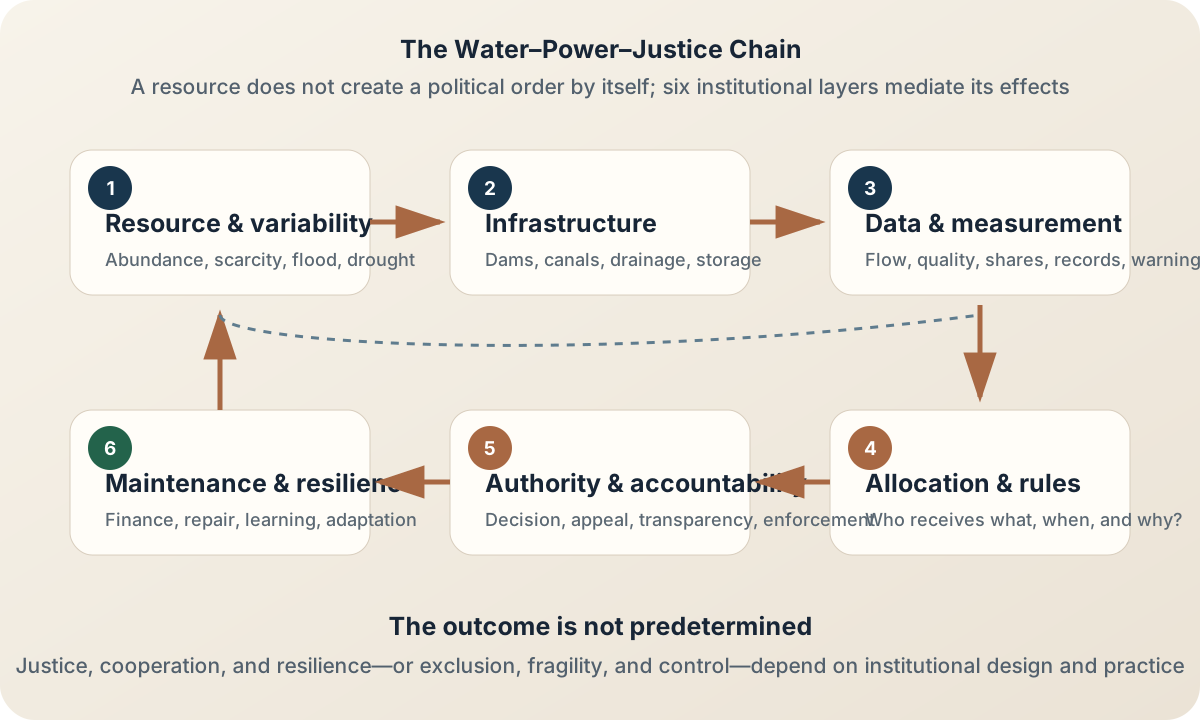
The Water–Power–Justice Chain: six layers instead of one cause
The proposed framework contains six layers. Its purpose is to block unjustified leaps from “water exists” to “a central state appears,” or from “a dam exists” to “distribution was fair.” A system can be strong at one layer and weak at another.
1. Resource and variability
How much water exists, and how does it vary across seasons and years? Is the dominant risk scarcity, flood, pollution, or volatility? Climate sets opportunities and constraints without writing a political rule by itself. The IPCC’s Sixth Assessment estimates that roughly half the world’s population experiences severe water scarcity during at least part of the year, driven by both climatic and non-climatic factors.[9] Natural and social pressures are intertwined at the first step.
2. Infrastructure
Do users depend on private wells, community canals, or large dams, pumps, and networks? Infrastructure does more than move water; it creates control points. A gate, pump, reservoir, or drain can serve a public function or become leverage. Every structure also has an operating life and a maintenance burden, so political capacity cannot be inferred from monumental scale alone.
3. Data and measurement
Who knows the volume, flow, storage, and quality? Are data public, current, and intelligible? OECD principles and UNESCO reporting treat consistent, shared information as a governance function rather than a technical afterthought.[5][8] An authority that monopolises numbers can describe denial as necessity and privilege as neutral calculation, leaving affected users unable to establish their claim.
4. Allocation and rules
Who receives what, when, and with which priority? Is drinking water protected during drought? How are shares distributed between head- and tail-end users, cities and farms, agriculture and ecosystems? A written rule is not just because it is written. Analysis must ask who drafted it, who was excluded, and how it treats weaker users and future generations.
5. Authority and accountability
Who enforces the rule and imposes penalties? Is there appeal, independent oversight, or disclosure of conflicts? This is where administration separates from domination. Authority is necessary in complex systems, but service without limits can become dependency. Justice is not measured by the presence or absence of the state; it is measured by whether decisions can be explained, reviewed, and corrected.
6. Maintenance and resilience
Are money, labour, and knowledge available to remove sediment, repair gates, monitor salinity, and revise drought rules? Systems often fail not because the original design was irrational, but because maintenance, learning, or trust eroded. Historical engineering work on Ma’rib shows repeated raising and structural adaptation in response to sedimentation, making maintenance part of the system’s history rather than a footnote.[18]
Why water is a contemporary power question, not only an archaeological topic
Water underpins drinking, health, food, energy, industry, and ecosystems. Agriculture remains the largest global user of freshwater. Current FAO material places its share of withdrawals around 72 percent, while emphasising major regional variation.[6][7] The percentage does not make every basin identical, but it shows why irrigation rules reach far beyond farm engineering: they shape food, labour, rural survival, and market prices.
Pressure is not distributed evenly. A user with capital for a deeper well, a more efficient pump, or political access to an allocation committee may remain productive while small farmers exit first. When shares are reduced without transparent data, compensation, or appeal, a technical decision becomes a crisis of legitimacy. The 2024 UN World Water Development Report connects water security and equitable access with prosperity and peace, while warning that poverty, inequality, and conflict can amplify insecurity.[8]
Nor is the phrase “water is a right” operational by itself. Pipes, treatment, finance, and accountable utilities still matter. Conversely, calling water an economic good cannot justify denying a safe and affordable basic level. The UN General Assembly’s contemporary human-rights framework establishes that access is not merely an act of administrative generosity.[11] Making that right effective requires institutions capable of delivery, oversight, and correction.
The OECD’s twelve principles organise water governance around effectiveness, efficiency, and trust and engagement. They include clear roles, appropriate scale, policy coherence, capacity, data, finance, regulation, innovation, integrity, participation, trade-off management, and periodic evaluation.[5] Their value is diagnostic: the question becomes not “who is strongest?” but “can the system be understood, inspected, and corrected?”
Does large irrigation produce despotism? Evidence rejects inevitability while preserving the concentration risk
Hydraulic theories famously linked the labour demands of large irrigation works to centralised authority and then to despotic government. Coordination is indeed necessary for many large systems. The error is to turn that observation into a universal sequence in which every irrigation society acquires the same political form.
Anthropological and archaeological comparisons are less tidy. Davies reviews evidence that has been used to criticise hydraulic determinism, including irrigation without pronounced hierarchy, while also warning against dismissing every connection between irrigation management and the formation of authority.[14] The stronger conclusion is conditional: scale, divisibility, landholding, exclusion costs, and rule formation all matter.
Nepal supplies a powerful counterexample to the claim that only a central agency can manage irrigation. Work by Ostrom, Lam, and Lee, followed by Bastakoti and Shivakoti, documents farmer-managed systems capable of rule-making, labour mobilisation, and enforcement; in studied samples, some performed better institutionally than agency-managed systems.[12][13] Yet “local is always better” would simply replace one dogma with another. Local institutions can exclude women or poorer users, weaken under migration, lack capital for major works, or be captured by local elites.
Angkor offers a third configuration. State-sponsored hydraulic works interacted with local temple communities, followed over time by greater concentration of land and management. The study does not say centralisation alone caused decline. It demonstrates institutional change and suggests that concentration can reduce local autonomy while adding vulnerability to an increasingly complex network.[21]
Ancient Yemen shows why material and symbolic power must be analysed together. Harrower rejects the original deterministic hypothesis but retains a major role for large irrigation in state formation and political prestige: rulers did not merely collect resources; they could present themselves as agents who turned hyper-arid landscapes into productive oases.[15] Water generated food and legitimacy at once.
The theoretical result
Irrigation does not give birth to despotism, but it creates strategic positions. Control over finance, gates, records, and enforcement can accumulate power unless constrained by transparent rules, multiple centres of decision, user rights, and independent review. Decentralisation likewise does not guarantee justice when the local community is itself unequal.
Ma’rib: the system, not the wall—and a history, not a single-cause tale
UNESCO describes the Landmarks of the Ancient Kingdom of Saba at Ma’rib as seven archaeological components demonstrating a complex society, organised administration, urban and ritual centres, and extensive irrigation. The Ma’rib dam fed canals that made large-scale cultivation possible in a semi-arid setting and helped create a major artificial oasis.[16] The case supports the manuscript’s central intuition: a dam is not merely masonry but knowledge, labour, allocation, maintenance, and administrative memory.
Ma’rib should not, however, become a poster story about one brilliant wall collapsing through one simple cause. Vogt’s work on the northern sluice identifies earlier phases, repairs, and architectural and functional development. Research on siltation shows sediment accumulation and repeated raising or modification of the system to extend its useful life.[17][18] The value of the case lies not in denying failure but in revealing that survival itself was a sequence of adaptation.
The evidence also does not justify saying that Sabaean centralisation was mechanically caused by dam scale. Harrower argues that large systems were not always an agricultural necessity in a narrow sense and carried a social and ideological role in state formation.[15] Causation may therefore have run in both directions: complex works required coordination, while political authorities also enlarged works that displayed and reproduced their capacity.
The Qur’an presents Saba through organised abundance, a command to give thanks, turning away, and consequence.[3] This is a layer of meaning, not a substitute for dating sluice repairs or modelling sediment. Nor may archaeology be used to erase the ethical question because it does not measure gratitude. The honest method keeps the tracks adjacent: material evidence reconstructs the system as far as surviving traces allow; scripture evaluates the human relation to gift and consequence.
What Ma’rib teaches contemporary governance
A great project is not the one that opens impressively but the one a society can maintain, correct, and distribute across generations. Infrastructure that expands faster than institutional capacity creates deferred debt: sediment not removed, gates not repaired, records not updated, or trust slowly lost. The wall may remain visible while the system around it becomes ill.
Mesopotamia: when additional water becomes slow-moving salt
Irrigated agriculture in southern Mesopotamia demonstrates the difference between immediate benefit and cumulative consequence. In hot, arid, poorly drained environments, irrigation can raise the water table while evaporation leaves salts near the surface. Over time, plants may take up water less effectively and yields can fall. Jacobsen and Adams developed a classic account of salt and silt, while Artzy and Hillel later defended the geoarchaeological mechanism of progressive salinisation.[19][20]
The case loses value if converted into a closed story—“salt brought down Mesopotamian civilisation.” Regional history includes shifting channels, inter-city and imperial conflict, trade, taxation, warfare, demographic change, and climate. Salinity is a measurable mechanism in particular places and periods, not a universal key to every transformation.
The institutional implication is deeper than any single cause. Irrigation demands drainage, canal cleaning, and allocation records. Delaying maintenance may appear inexpensive for a year while its cost accumulates in the soil. A political order that rewards rapid extraction and suppresses inconvenient information can look powerful while consuming its own foundation. This is compound fragility: small pressures build across environment, institution, and trust until a shock appears to be the sole cause.
The framework therefore asks whether a water system measures what is slow or invisible: groundwater levels, salinity, leakage, storage decline, and access inequality. A system that measures only today’s delivered volume may succeed administratively while failing historically.
Shared water: rights, cooperation, and the limits of unequal power
Transboundary basins make interdependence explicit. An upstream decision changes downstream conditions; pollution crosses borders; droughts and floods require shared warning and information. The UNECE Water Convention requires reasonable and equitable use, specific agreements, and joint bodies among riparian parties.[10]
Formal cooperation is not automatically equal. An upstream state may possess greater storage, better data, or more political leverage, while an agreement remains weakly enforceable. Still, joint institutions, data exchange, allocation procedures, and warning systems can convert part of raw interdependence into monitorable rules. UNECE reporting documents joint work on data, pollution, allocation, floods, and droughts.[10]
This connects directly to the human rights to safe drinking water and sanitation.[11] Rights do not abolish scarcity or trade-offs, but they establish a moral and legal floor: poverty, identity, or location should not automatically deny a safe basic level. When rationing is unavoidable, decisions need public reasons, review, and protection against concealed privilege.
Water can therefore contribute to peace or tension. The 2024 UN report does not offer the slogan “water creates peace.” It ties outcomes to access, inequality, cooperation, and the wider context of poverty and conflict.[8] Good water politics does not eliminate disagreement; it prevents disagreement from becoming a secret entitlement of the stronger party.
The Qur’anic layer: measure, balance, and gratitude without turning scripture into a technical report
Qur’an 23:18 describes water sent down “in due measure” and lodged in the earth.[1] The language of measure disciplines perception: water is not an unlimited stock over which human beings exercise absolute ownership. Yet the verse does not calculate a sustainable aquifer yield and cannot replace a monitoring station. It directs purpose; application still requires science.
Qur’an 55:7–9 connects the balance with justice and a prohibition against diminishing it.[2] In this dossier, measurement is ethically loaded because rights depend on it. Flow meters, irrigation shares, property registers, and storage figures are not neutral when an error, forgery, or concealment transfers loss from one person to another.
Pharaoh’s claim—“Does not the kingdom of Egypt belong to me, and these rivers flow beneath me?”—turns geography into political legitimation.[4] In a river society, water is not scenery; it touches food, tax, work, and movement. This is a political reading of the verse, not a claim that it contains a modern water-governance theory. Its analytical force lies in exposing a recurring logic: public abundance is presented as personal proof of entitlement to obedience.
The Saba passage combines a good land, provision from the Lord, a command to give thanks, turning away, and the flood.[3] The text does not authorise us to label every hydraulic failure a known divine punishment, and archaeological traces do not invalidate gratitude because they cannot measure it. Each level keeps its instrument: laboratories measure salt, archaeology reconstructs canals, institutional analysis studies rules, and revelation places the human being before stewardship and consequence.
The dossier’s balance
Science explains how water flows, contaminates, evaporates, and salinises soil. History shows how societies built dams, canals, and records. Institutional research examines rules and incentives. The Qur’an asks who gave the resource, by what right it is governed, whether people uphold justice, and what follows from corruption. No level cancels another.
Serious objections and bounded answers
1. Is centralisation not necessary for large infrastructure?
It may be necessary for particular functions: financing a major dam, coordinating a basin, or enforcing quality standards. Functional necessity does not confer unlimited authority. A polycentric arrangement can assign standards and finance to the state, basin coordination to joint bodies, local operation to user groups, and review to independent courts or regulators. The issue is not central or local as rival creeds; it is matching each function to the level with knowledge, capacity, and accountability.
2. Is local management always better?
No. Nepal demonstrates possibility, not immunity.[12][13] A local family may capture a gate, landless users may be excluded, or the group may lack finance for major upgrades. The strongest arrangement uses local knowledge while preventing custom from becoming a closed privilege.
3. Is climate not the decisive factor?
Climate strongly alters supply and risk, and anthropogenic climate change is intensifying water insecurity in multiple regions.[9] It does not decide who bears the loss. The same drought can produce transparent rationing that protects basic needs, or opaque markets that punish the poor. The shock may be partly natural; its distribution is political.
4. Can gratitude and justice be empirically tested?
Not in the same way as flow or salinity. Institutional correlates of justice—access inequality, transparency, appeal, or burden-sharing—can be studied. The devotional meaning of gratitude belongs to ethical and religious discourse. Claiming that science proves or disproves it would exceed science’s scope.
5. Is the water–power link too obvious to be useful?
The general phrase is obvious and analytically weak. The contribution is to disaggregate “power” into access points, data, measurement, allocation, enforcement, and maintenance. These variables can be compared across a central dam, a local canal, an urban utility, and a transboundary basin rather than remaining a political metaphor.
What could change the conclusion?
The synthesis should be revised if representative global historical data show irrigation scale alone robustly predicting one political form; if institutional comparisons find transparency, participation, and accountability unrelated to fairness or resilience; or if new excavation, dating, and sediment models substantially change the reconstruction of Ma’rib or Mesopotamian salinity. The claim–evidence appendix records a specific caveat and revision condition for every claim.
Core claim map
| ID | Condensed claim | Confidence | Class |
|---|---|---|---|
| C01 | Institutions mediate water’s political effects; the resource alone does not determine civilisation. | High | Synthesis |
| C02 | A water system is a cycle of operation, information, allocation, maintenance, and review—not a structure alone. | High | Governance |
| C03 | Irrigation without drainage and maintenance can generate slow salinisation and degradation. | High | Environmental |
| C04 | Large irrigation does not inevitably produce despotism; central, local, and hybrid systems exist. | High | Historical theory |
| C05 | Self-governance can outperform agency management in some settings, but is no universal recipe. | Medium–high | Institutional |
| C06 | Opaque concentration of access, data, and sanctions raises the risk of control. | Medium–high | Power analysis |
| C07 | Stronger governance combines roles, data, finance, integrity, participation, and evaluation. | High | Governance standard |
| C08 | Shared water can support institutional cooperation; conflict is not inevitable. | High | Cooperation |
| C09 | Ma’rib was a multi-phase system of construction, repair, and adaptation—not a one-cause tale. | High | Case study |
| C10 | Qur’anic ethics adds a normative layer without replacing material science. | High | Methodological |
Full wording, supporting sources, limitations, and revision conditions are available in both HTML and JSON through the claim–evidence appendix.
Alhafiz, Ahmed. “Water, Civilization and Power: When Does Resource Governance Produce Justice—and When Does It Become Control?” Version 1.0, 2 September 2026, Ahmed Alhafiz official site.
Annotated references
- Qur’an 23:18نص قرآني / Qur’anic text
The verse links water with measure and emplacement in the earth; used here for ethical framing, not as a hydrological dataset.
- Qur’an 55:7–9نص قرآني / Qur’anic text
The textual basis for balance, justice, and non-diminution; not a substitute for institutional analysis.
- Qur’an 34:15–17نص قرآني / Qur’anic text
The Saba passage links organised abundance, gratitude, and the flood; its moral meaning is kept distinct from archaeological causal reconstruction.
- Qur’an 43:51نص قرآني / Qur’anic text
Pharaoh invokes kingship and rivers as political legitimation, providing a textual entry into resource-based claims of authority.
- OECD Principles on Water Governanceمعيار حكومي دولي / Intergovernmental governance standard
Twelve principles covering roles, scale, data, finance, integrity, participation, trade-offs, and monitoring.
- FAO: Agricultural Water Managementمصدر رسمي / Official data and policy source
Identifies agriculture as the largest global freshwater user and connects water management to food security and resilience.
- FAO SDG 6: Water-use efficiency and water stressبيانات رسمية / Official indicator data
Current official indicators for water stress and sectoral withdrawals, with large regional variation.
- UN World Water Development Report 2024: Water for Prosperity and Peaceتقرير أممي / UN flagship report
Links water security and equitable access with prosperity and peace, while warning that inequality can undermine stability.
- IPCC AR6 WGII, Chapter 4: Waterتقييم علمي دولي / International scientific assessment
Assesses climate-driven changes in the water cycle, scarcity, floods, and adaptation with explicit confidence levels.
- UNECE: Progress on Transboundary Water Cooperation 2020–2023تقرير اتفاقية دولية / Treaty implementation report
Documents reasonable and equitable use, specific agreements, joint bodies, and data exchange under the Water Convention.
- UN General Assembly Resolution A/RES/80/216 on the human rights to safe drinking water and sanitationقرار أممي / UN resolution
Affirms the contemporary rights framework: safe, acceptable, affordable access is not merely administrative discretion.
- Ostrom, Lam & Lee (1994), The Performance of Self-Governing Irrigation Systems in Nepalبحث محكّم / Peer-reviewed study
An institutional study challenging the assumption that only central government can manage shared irrigation resources.
- Bastakoti & Shivakoti (2012), Rules and collective action in Nepal irrigation systemsبحث محكّم / Peer-reviewed study
Compares rule formation and enforcement in farmer-managed and agency-managed systems.
- Davies (2009), Wittfogel’s dilemma: heterarchy and irrigation managementبحث أثري/أنثروبولوجي محكّم / Peer-reviewed archaeology and anthropology
Critiques simplistic hydraulic-despotism claims while retaining the question of when irrigation contributes to loci of authority.
- Harrower (2009), Is the hydraulic hypothesis dead yet? Irrigation and social change in ancient Yemenبحث أثري محكّم / Peer-reviewed archaeology
Rejects one-cause determinism while retaining the importance of large irrigation systems for state formation and ideological prestige in ancient South Arabia.
- UNESCO World Heritage Centre: Landmarks of the Ancient Kingdom of Saba, Maribسجل تراث عالمي رسمي / Official World Heritage record
Documents seven sites, complex central administration, and extensive irrigation linked to the Ma’rib dam and a major artificial oasis.
- Vogt (2023), Research status of the Great Dam of Ma’rib after the 2005/2006 campaignبحث أثري / Archaeological research
Examines architectural evolution, sluices, repairs, and earlier phases—evidence for a layered technical history rather than a one-off structure.
- Garbrecht & Garbrecht, Siltation Behind Dams in Antiquityبحث هندسي تاريخي / Historical engineering study
Examines sedimentation, dam raising, and structural adaptation at Ma’rib, showing maintenance as part of infrastructure life.
- Jacobsen & Adams (1958), Salt and Silt in Ancient Mesopotamian Agricultureبحث محكّم / Peer-reviewed study
A classic study of salinity and silt in ancient irrigated agriculture; insufficient by itself as a total explanation of regional history.
- Artzy & Hillel (1988), Progressive soil salinization in ancient southern Mesopotamiaبحث محكّم / Peer-reviewed geoarchaeology
Explains salinization and soil degradation in poorly drained arid river valleys.
- Klassen & Evans (2020), Top-down and bottom-up water management at Angkorبحث أثري محكّم مفتوح / Open peer-reviewed archaeology
Shows coexistence of state and community systems followed by increasing concentration of land and management over time.
Version history
Initial release: a six-layer analytical framework, ten traceable claims, full Arabic and English editions, a bilingual evidence appendix, citation files, structured data, and technical link validation. No independent specialist review has yet been completed.