Author, structure, source, and link review complete. No independent specialist in cosmology or Qur’anic exegesis has yet reviewed this dossier, and it is not an academically peer-reviewed publication.
Direct answer
The evidence does not justify saying that Qur’an 21:30 gives a technical scientific description of Big Bang cosmology. It also does not force the conclusion that no meaningful comparison is possible. The verse presents the heavens and earth as ratq and then says God fatq-ed them, links water with life, and closes with an appeal to belief. Classical exegesis does not reduce the words to one meaning: it records joining and separation, differentiation of heavens and earths, and the sky withholding rain and earth withholding vegetation before both were opened. Modern cosmology, meanwhile, describes a universe that was once hotter and denser and has expanded, supported by multiple independent observations. A cautious broad comparison is therefore defensible. Technical identity, exclusive exegesis, and claims that cosmology empirically proves creation ex nihilo or divine agency are not.
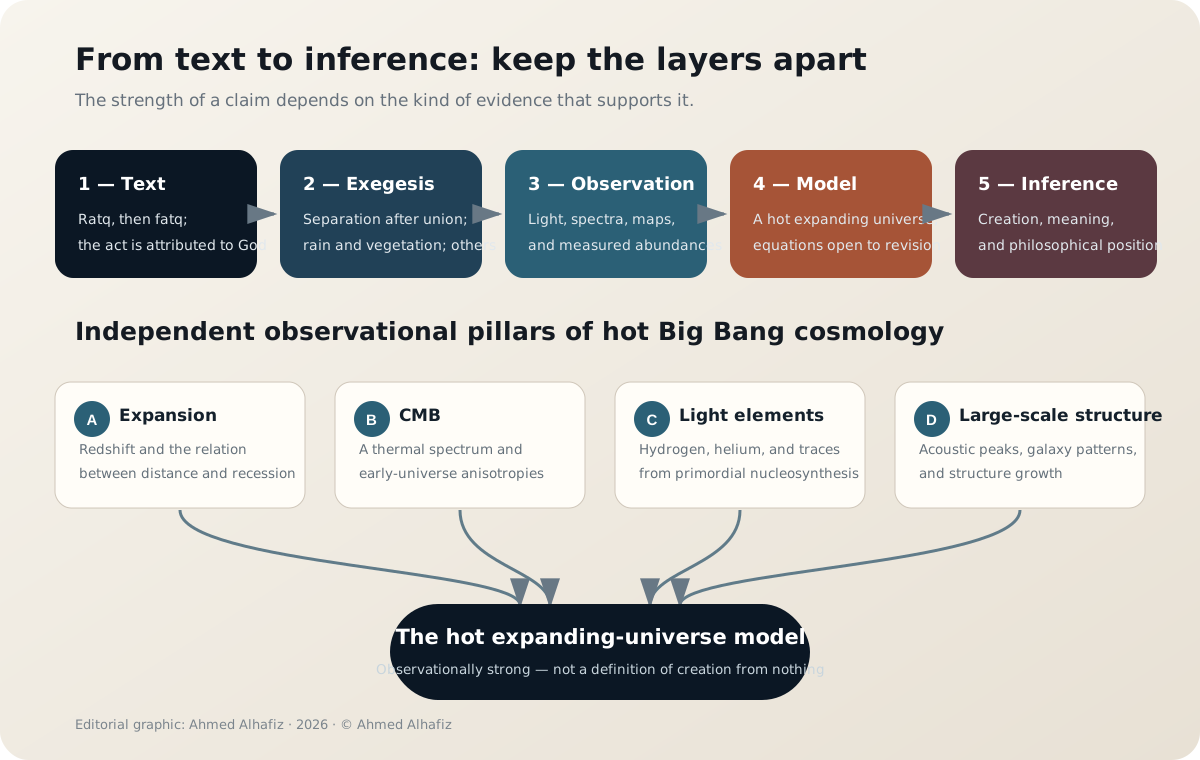
Claim map before exposition
| ID | Claim | Confidence | Boundary |
|---|---|---|---|
| C01 | The verse states ratq then fatq attributed to God, but contains no Big Bang terminology or equation. | High | Textual reading, not scientific substitution. |
| C02 | Classical exegesis preserves multiple interpretations. | High | No historical consensus on a modern model. |
| C03 | The Big Bang is not a bomb exploding from a central point into prior emptiness. | High | It is the history of expanding space and a hot dense state. |
| C04 | The hot expanding model is supported by independent evidence. | High | A strong core does not make every detail final. |
| C05 | The model alone does not prove creation from nothing, agency, or purpose. | High | A boundary of empirical scope, not a disproof of theology. |
| C06 | Broad comparison is possible; technical identity is not demonstrated. | Medium | An integrative judgment by the author. |
| C07 | Cosmological details remain revisable despite strong observational foundations. | High | Tensions are not the collapse of hot Big Bang history. |
The full evidence appendix provides source notes and links to the bilingual machine-readable ledger.
Why five layers matter
“This verse is the Big Bang” compresses five questions: what the words say, how interpreters understood them, what astronomers measured, what model connects the measurements, and what metaphysical conclusion a reader draws. Interaction between these layers is legitimate. Substituting one for another is not.
- Text: wording, grammar, context, and argumentative function.
- Exegesis: the human history of interpretation, with its plurality and methods.
- Observation: spectra, microwave measurements, abundances, and clustering.
- Model: a mathematical construction that unifies evidence and predicts results.
- Metaphysical or theological inference: agency, purpose, creation, and meaning.
A responsible religion-and-science comparison must say where the relation lies. If it claims prediction, it must ask what was specific before the science, whether rival interpretations existed, and whether the reading was selected retrospectively after the result became known.
What does the verse actually say?
“Have those who disbelieved not considered that the heavens and the earth were a joined entity, and We separated them, and made from water every living thing? Then will they not believe?” — Qur’an 21:30, a common English rendering.[1]
The minimum structure is clear: an argumentative question; a state called ratq; a fatq attributed to God; a move to water and life; and a theological conclusion. Ratq carries the sense of closing, joining, or being sewn up; fatq is opening or separating. This lexical opposition does not, by itself, specify a physical state, date, metric, or mechanism.
The verse does not say “singularity,” “scale factor,” “cosmic microwave background,” or “inflation.” Nor does it describe a popular explosion in which matter flies from a center. Those are later scientific or popular concepts. Precision requires preserving the text while refusing to smuggle later vocabulary into its literal wording.
Yet precision also prevents emptying the verse of transition. Whatever ratq denotes in a given interpretation, the statement presents one condition followed by a transformative act and places that sequence within a theological argument about power and life.
Classical exegesis is plural, not silent
Al-Tabari records several reports: one group relates the words to the differentiation of heavens and earths; another explains that the sky was closed from rain and the earth from vegetation, then each was opened.[2] Al-Qurtubi explains ratq as closure, the opposite of fatq, and then preserves accounts of joining, separation, and differentiation.[3] Ibn Kathir includes an account in which the whole was connected and separated, while also citing the rain-and-vegetation interpretation.[4]
| Source | Readings reported | What this prevents |
|---|---|---|
| Al-Tabari | Differentiation of heavens/earths; or rain and vegetation withheld then opened. | Claiming a unique premodern cosmological reading. |
| Al-Qurtubi | Closure versus opening; joining and separation; differentiation. | Turning the lexical pair into one mathematical model. |
| Ibn Kathir | Connection and separation, alongside rain and vegetation. | Presenting classical exegesis as a single modern prediction. |
This plurality does not forbid a cosmic reading. It changes its epistemic status. One may say that some inherited readings make a broad comparison possible. One may not say that classical commentators unanimously taught Big Bang cosmology.
What does “Big Bang” mean in science?
The name is misleading if it evokes a firecracker at a place. Modern cosmology does not describe matter flying outward from one center into an external void. Space itself expands, and on sufficiently large scales distant galaxies recede from one another. NASA’s John Mather explicitly warns against the firecracker picture.[7]
“Hot Big Bang” is often the more informative phrase. Running cosmic expansion backward implies earlier conditions of greater density and temperature. As the universe cools, nuclear reactions change, atoms form, radiation decouples, and density perturbations grow into structure. This is a physical history. It is not, on its own, an answer to why anything exists or a complete description of an absolute first instant.
1. Expansion and redshift
Edwin Hubble’s 1929 paper identified a roughly linear relation between distance and radial velocity in the limited sample then available, while openly emphasizing the data’s uncertainty and the need for more distant objects.[5] It was not a complete proof of modern cosmology, but it became an important historical step from a static picture toward a dynamic universe.
2. The cosmic microwave background
Penzias and Wilson’s 1965 paper reported an approximately isotropic excess antenna temperature and pointed to the cosmological interpretation discussed in a companion paper.[6] COBE/FIRAS later measured a microwave background spectrum extremely close to a 2.725 K blackbody, a central prediction of a hot thermal history.[9]
The CMB is not a photograph of creation. It is the oldest electromagnetic light we can directly observe, released when the universe became transparent roughly 380,000 years into the standard timeline.[8] Its small anisotropies encode information about composition, geometry, and the seeds of later structure.
3. Acoustic structure and Planck
Planck’s final cosmological-parameter analysis found good consistency among temperature, polarization, and lensing data within a spatially flat six-parameter ΛCDM model, including an exceptionally precise angular acoustic scale.[10] Its likelihood paper also discusses residual modelling uncertainties and statistical curiosities, demonstrating that precision cosmology includes stress-testing rather than eliminating uncertainty.[11]
4. Primordial nucleosynthesis
A hot early universe permits quantitative calculations of light-element abundances as functions of baryon density and nuclear reaction rates. The broad agreement of deuterium and helium with the same framework is independent support, while lithium remains a known difficulty. The Particle Data Group maintains specialist reviews of Big Bang cosmology, nucleosynthesis, cosmological parameters, and the CMB.[12]
5. Large-scale structure and BAO
Early acoustic waves leave a preferred scale in later matter clustering. DESI uses baryon acoustic oscillations across galaxies, quasars, and the Lyman-alpha forest to reconstruct expansion history. Three-year results strengthened hints of evolving dark energy in combinations with some other datasets, while a July 2026 full-shape Lyman-alpha result moved toward ΛCDM and left the interpretation open.[13][14] This is a useful case: a robust expansion history can coexist with active revision of dark-energy details.
Convergence, not a single spectacular image
The hot expanding model is strong because several different measurements enter one quantitative story. A rival must explain not only redshifts, but the microwave spectrum and anisotropies, primordial abundances, and the statistical structure of matter. This convergence is more important than any isolated picture or slogan.
It also shows why superficial “scientific miracle” content is weak. A galaxy image next to a verse is not an argument. A serious comparison must preserve the logic of the science and the plurality of exegesis, rather than simplifying both until they merely resemble each other.
Where can a comparison responsibly stand?
The strongest point is general structure: the Qur’anic wording presents ratq followed by fatq; some classical readings understand joining or a collective state followed by differentiation; modern cosmology describes an observable universe evolving from a hotter, denser condition into expansion and structure. This is a reasonable locus of reflection or broad compatibility.
“Identity” is too strong. The verse does not specify parameters or mechanism, exegesis is not singular, and “the heavens and the earth” is not automatically identical to the technical object denoted by “the universe” in modern cosmology. Translation across conceptual systems requires argument.
| Statement | Assessment | Reason |
|---|---|---|
| “The verse states ratq then fatq.” | Textually supported | Directly grounded in the wording. |
| “Some classical readings describe joining then separation.” | Historically supported | Present alongside other readings. |
| “A broad comparison with hot Big Bang history is possible.” | Reasonable inference | Structural analogy with important differences. |
| “The verse is a Big Bang equation.” | Unsupported | No quantitative content or uniquely specified model. |
| “Big Bang cosmology empirically proves God.” | Category overreach | Physical history does not by itself identify metaphysical agency. |
What Big Bang cosmology does not establish
Creation from absolute nothing
A classical solution may approach a mathematical boundary or singular regime, but this is not an empirical observation of absolute nothing turning into something. Physical “vacuum” is not philosophical non-being. Competing quantum-cosmological proposals remain physical models with structures and assumptions.
Agency or purpose
Equations do not contain a variable for divine agency, but neither does their form negate it. A believer situates cosmic order within revelation and philosophical argument. A naturalist uses another framework. Measurements constrain physical histories; they do not settle every metaphysical interpretation by themselves.
A complete absolute first instant
Approaching regimes where quantum gravity matters exposes the limits of present theory. A singularity often signals the breakdown of a classical description rather than a photographed object. Researchers therefore distinguish the data-supported early universe from an absolute “time zero” about which no complete theory is established.
The strongest objections
“The reading was invented after modern science.”
The Big Bang comparison is necessarily modern, and it should never be presented as premodern scientific terminology. Retrospective comparison is not automatically worthless, but its value depends on what the text genuinely supports and whether rival interpretations are disclosed.
“Rain and vegetation is the actual interpretation.”
That reading is substantial and prevents exclusivity. It does not erase reports of joining or differentiation. The responsible result is plurality, not selecting whichever reading best serves a promotional claim.
“The cosmological model keeps changing.”
Scientific revision is part of the method. The observational core—expansion, thermal history, CMB, nucleosynthesis—must be distinguished from details such as inflationary mechanism, the nature of dark energy, or parameter tensions. Detailed verse-model identifications are fragile precisely because the details remain open.
“The similarity is too general to count as prediction.”
This is a strong objection to calling the verse an independent scientific prediction. Broad language has low discriminatory power. The comparison may still have reflective value for a believer, but that is different from a novel quantitative forecast.
Five formulations to retire
- “Ratq literally means the singularity.” It does not; this is a modern interpretive substitution.
- “Scientists proved that the universe was one ball.” The model concerns spacetime and cosmic contents, not a ball sitting in space.
- “All classical commentators agreed.” They did not.
- “Any tension overturns the Big Bang.” Dark-energy questions do not erase the microwave background or primordial nucleosynthesis.
- “Science validates revelation.” Scientific models are revisable; revelation is not grounded in their certification within the believer’s framework.
What could change this dossier?
The scientific confidence would change if a competing model explained expansion, the CMB spectrum and anisotropies, abundances, and large-scale structure substantially better, or if major observations contradicted the thermal history. The exegetical account would change if stronger textual work showed that a report or attribution was misrepresented. The integrative claim C06 is inherently disputable: a reader may judge the analogy weaker or stronger, provided neither the verse nor cosmology is made to say what it does not.
Conclusion
Qur’an 21:30 is not a cosmology paper, and cosmology is not Qur’anic exegesis. That distinction need not become a wall. A reader may see a broad resonance between ratq-to-fatq language and a cosmic history moving from hotter, denser conditions toward expansion and differentiation. The comparison becomes stronger—not weaker—when it retains three constraints: plural exegesis, general wording, and the empirical limits of the model.
Science establishes that the observable universe has a deep, measurable history. The verse places ratq, fatq, water, and life within a theological argument about God’s act and belief. Collapsing the layers diminishes both. Keeping them distinct makes the conversation honest enough to be useful.

Editorial relationship to a forthcoming book
The question developed from a chapter in Ahmed Alhafiz’s forthcoming Arabic book قل سيروا في الأرض فانظروا كيف بدأ الخلق. The manuscript is not evidence for the scientific or exegetical claims in this dossier. Its relationship is thematic; public sources carry the argument.
Book page and related researchAnnotated references
- Qur’an 21:30. Primary text Basis of the textual claim, not of modern cosmological details.
- Al-Tabari on 21:30. Classical exegesis Multiple transmitted readings, including differentiation and rain/vegetation.
- Al-Qurtubi on 21:30. Classical exegesis Lexical explanation and several reports; not every narrative is treated here as historically established.
- Ibn Kathir on 21:30. Classical exegesis Connection/separation and rain/vegetation traditions.
- Hubble (1929), PNAS. Original paper Historical velocity-distance relation with explicit limitations.
- Penzias & Wilson (1965). Original paper Excess microwave antenna temperature.
- NASA: Webb and the Big Bang. Official science explainer Corrects the explosion-at-a-center misconception.
- NASA Universe Overview. Official science overview Recombination and the CMB as the oldest observable light.
- NASA LAMBDA: COBE/FIRAS. Mission data Near-perfect blackbody spectrum and temperature.
- Planck Collaboration VI (2020). Peer-reviewed collaboration paper Cosmological parameters, ΛCDM consistency, and tensions.
- Planck Collaboration V (2020). Peer-reviewed collaboration paper CMB spectra, likelihoods, and robustness tests.
- Particle Data Group 2026 reviews. Specialist synthesis Big Bang cosmology, nucleosynthesis, CMB, and parameters.
- DESI DR2 2025 guide. Official survey publication guide BAO constraints and evolving-dark-energy hints.
- DESI DR2 Lyman-alpha, July 2026. Official survey update A newer probe closer to ΛCDM, illustrating live model testing.
Alhafiz, Ahmed. “Ratq, Fatq, and the Big Bang: Text, Exegesis, Evidence, and Limits.” Version 2.0, Official Website of Ahmed Alhafiz, 2 September 2026. https://ahmedalhafiz.com/en/articles/ratq-fatq-big-bang/Version history
Full English edition; five-layer separation; expanded observational evidence; claim ledger; objections and limits; explicit external-review status.