
Direct conclusion
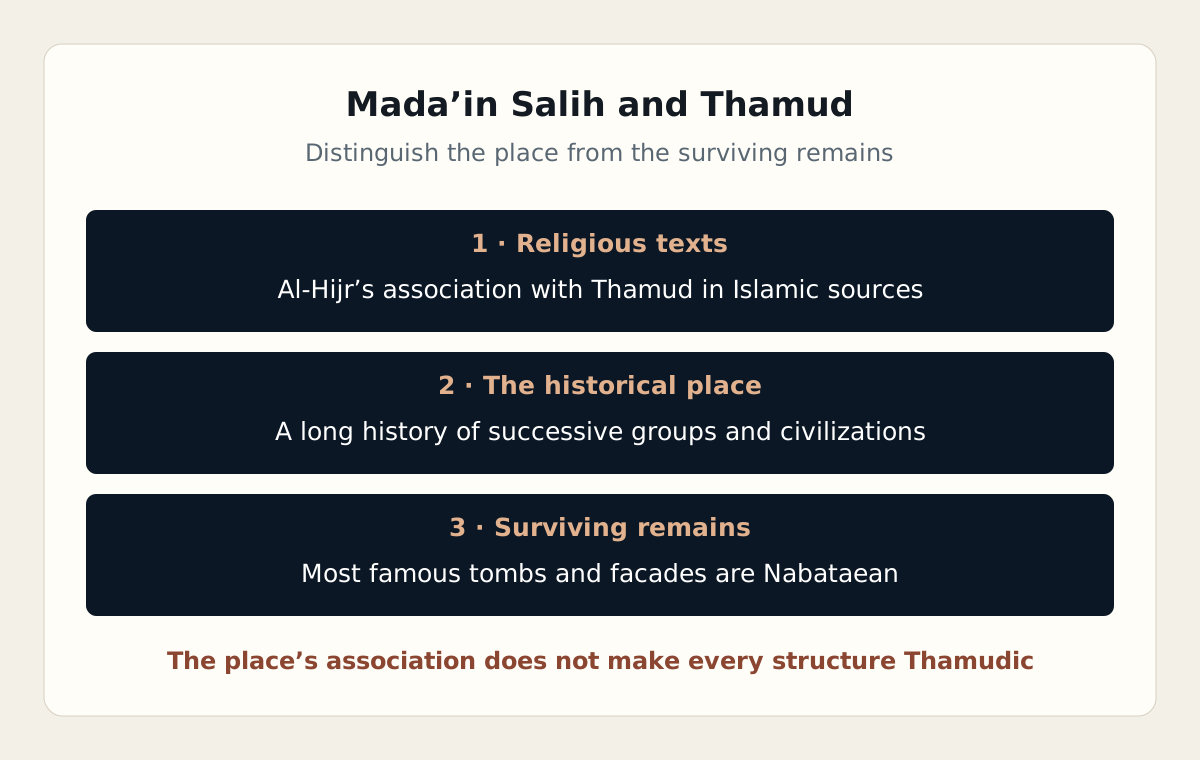
Al-Hijr is associated with Thamud in the Quran and Sunnah, but this does not mean that every rock-cut facade or visible tomb at Mada’in Salih was built by Thamud. Archaeological evidence and inscriptions attribute the monumental tombs with decorated facades, including Qasr al-Farid and Qasr al-Bint, to the Nabataeans; most date from the first century BCE to the first century CE. The more precise answer is that the place has a long, layered history. Its religious association with Thamud does not make all its surviving remains Thamudic.
This study’s connection to the book
This investigation expands pages 94–96 of Ahmed Alhafiz’s Qul Siru fi al-Ard fa-Unzuru Kayfa Bada’a al-Khalq. The book treats surviving rock-cut dwellings as evidence of a vanished civilization’s power, then notes that most famous surviving facades at Mada’in Salih are Nabataean rather than a direct record of Thamud’s architecture. The book is the origin of the question and intellectual path; archaeological and historical judgments depend on the independent sources declared below.
Why does confusion arise?
Images of Mada’in Salih appear in books, travel websites and videos under descriptions such as “Thamud’s houses” or “Thamud’s palaces.” Repetition makes the description seem settled: Thamud carved this facade, and that tomb was one of their homes.
The picture is simpler than the history. Different groups and civilizations occupied the site, and its remains do not all belong to one period. Nor must the Quranic word house match the function of every carved building we see today: many of the most famous facades are Nabataean burial places bearing inscriptions that date them and identify their owners and rights of use.
We must therefore distinguish three questions:
- Do Islamic texts associate Al-Hijr with Thamud?
- Did people live in the region before the Nabataeans?
- Who carved the famous facades and burial places that survive today?
Confusing these questions is the root of the problem.
What do the Quran and Sunnah say about Al-Hijr and Thamud?
The Quran mentions the people of Al-Hijr in Surah Al-Hijr, saying that they carved secure houses from the mountains before the blast overtook them for their denial. Elsewhere it mentions Thamud and their prophet Salih, describing their mountain carving: “And you carve houses out of the mountains skillfully” [Al-Shu‘ara: 149].
In an authentic hadith, the Prophet passed Al-Hijr on his way to Tabuk and forbade his companions from entering the places of those punished unless they were taking heed and weeping. Al-Bukhari and Muslim transmitted the report from Abdullah ibn Umar.[2]
There is thus a clear religious association between Al-Hijr and the people who denied their prophet. But the religious text does not provide an archaeological catalogue assigning every standing facade to them or dating every visible tomb or inscription. This does not diminish the text’s meaning; it prevents attributing to it a detailed archaeological claim it never made.
What do the surviving remains tell us?
UNESCO classifies Al-Hijr, or Mada’in Salih, as the largest preserved site of Nabataean civilization south of Petra. The monumental tombs with decorated facades generally date from the first century BCE to the first century CE. According to UNESCO, the site contains 111 monumental tombs, 94 of them decorated.[3]
The Royal Commission for AlUla describes Hegra as the principal southern city of the Nabataean kingdom; official sources describe more than a hundred preserved Nabataean rock-cut tombs.[4]
This attribution rests on more than architectural resemblance. Nabataean inscriptions appear on several entrances, sometimes identifying the tomb’s owner and rules governing burial, ownership and penalties for infringement. Decoration, lettering and architectural styles also belong to the known Nabataean world extending north to Petra.
Most famous rock-cut facades visited at Mada’in Salih today are therefore Nabataean burial places, not houses archaeologically established as carved by Thamud.
Was Qasr al-Farid built by Thamud?
Qasr al-Farid is Al-Hijr’s most famous monument. Its popular name may suggest a residential palace, but it is an unfinished Nabataean tomb, carved alone into a large rock mass. Its unfinished state reveals the sculptors’ practice of working down from the top of the facade.[5]
No sound archaeological evidence establishes it as Prophet Salih’s house, a Thamud leader’s house or the building from which the she-camel emerged. These popular names and stories should not be confused with what inscriptions and excavation establish. The same applies to many photographed facades: their beauty and grandeur are real, but the lesson does not require attributing a monument to the wrong makers.
Does this mean Thamud were absent from the region?
No. Rejecting the attribution of Nabataean tombs to Thamud does not reject Al-Hijr’s association with Thamud.
More precisely, the region predates its Nabataean phase; UNESCO itself mentions inscriptions and drawings from earlier periods.[3] Finding an older trace, however, does not automatically name its makers or establish that a particular building belonged to the Thamud mentioned in the Quran.
Here the limits of archaeology become clear. A researcher can study an occupation layer, date an inscription, analyze pottery and compare an architectural style. They cannot attribute every unidentified trace to a religious or historical name without direct evidence.
Conversely, the absence of a building labeled “this is Thamud’s house” cannot refute the religious account. Material evidence survives under the effects of time, reuse, erosion and the limits of discovery so far.
Are “Thamudic” inscriptions direct evidence?
This point is especially prone to misunderstanding. Nineteenth-century researchers used Thamudic for large groups of inscriptions in ancient North Arabian alphabets that had not yet been precisely classified. Oxford’s Ancient North Arabian inscription project explains that the technical label does not mean all these inscriptions were written by members of the Thamud tribe or belong to one period or region.[6]
“A Thamudic inscription” alone therefore does not establish that its writer belonged to Salih’s people. It is an older scholarly label for a category of writing, not a ready-made ethnic identity card.
This guards against two opposing errors: using inscriptions to prove details they do not contain, and claiming that archaeology contradicts the Quran because its terminology is more complex than popular usage.
One place can carry the histories of several peoples
An archaeological site is not a frozen image of one moment. An oasis may be used for centuries, trade routes change, new inhabitants arrive, tombs are carved beside older remains, and caravans, pilgrims and railways later pass through.
Al-Hijr is thus an earthly record with many pages. Nabataean tombs do not erase what preceded them, and the place’s association with Thamud does not erase what the Nabataeans built later. The error begins when we compress all these layers into one name and one period.
This is close to the method underlying Qul Siru fi al-Ard: traveling through the earth is not a search for an image confirming what we already know, but training in reading evidence honestly and distinguishing observation, interpretation and inference.
How do archaeologists identify the tombs as Nabataean?
Dating rests neither on visual impression nor on assuming that all similar carving belongs to one people. Several indicators converge: inscriptions on some facades; owners’ names and formulas concerning property and prohibition; Nabataean letter shapes; capitals and facade styles; finds and architectural context; and comparisons with dated buildings elsewhere in the Nabataean world. When they agree, attributing a tomb to the Nabataean phase becomes stronger than a circulated story.
Inscriptions show that a facade was not always a residential “palace.” Some specify who may be buried there, who may not open or sell the tomb, and penalties for infringement. Its funerary and legal function is clear. A popular name such as Qasr al-Farid helps identify a monument, but does not establish its historical function or owner.
Older remains require the same caution. A pre-Nabataean rock inscription or drawing establishes earlier human activity without automatically naming the group. Language, writing style, find location and geological context may narrow the possibilities. Without an explicit date or a verifiable name, attribution remains open. This describes the surviving material’s limits honestly, rather than a defect in science.
Does the lesson change if the facades are Nabataean?
The lesson does not depend on a familiar image being the very monument seen by Salih’s people. The verses describe people who carved mountain houses but whose strength did not prevent the outcome. Visiting a site occupied by successive civilizations adds another meaning: later people may build over earlier remains, and their own buildings become a layer read by those who follow.
The problem arises when the force of an admonition depends on attributing a specific monument without evidence. A reader learning that Qasr al-Farid is Nabataean may then mistakenly think this refutes Al-Hijr’s association with Thamud or weakens the verse. Distinguishing the text, the place’s identification and each structure’s date preserves both the lesson and archaeological precision.
Travel and observation thus become an intellectual and ethical practice together: examine the trace, ask who made it, when and for what purpose, state the degree of certainty, then take heed. We do not start with a conclusion and force the stone to support it, or use what remains undiscovered as an excuse to fill the gaps with any story.
What do we know, and what do we not know?
| Issue | Status of the judgment |
|---|---|
| Al-Hijr’s association with Thamud’s story in the Quran and Sunnah | Established in Islamic sources |
| Human history in the region before the Nabataeans | Supported by pre-Nabataean inscriptions and remains |
| Attribution of the famous decorated tombs to the Nabataeans | Archaeologically established through inscriptions, dating and style |
| Treating Qasr al-Farid as a house of Thamud | Not established |
| Treating every inscription labeled “Thamudic” as written by Salih’s people | Methodologically unsound |
| Identifying every building carved by Thamud within the present site | Unavailable from the existing archaeological evidence |
Final answer
Al-Hijr is the place associated with Thamud in Islamic texts, but the prominent surviving remains at Mada’in Salih do not all belong to Thamud. Most famous tombs and facades are Nabataean and later in date, while the site preserves traces and inscriptions from several earlier phases. We must distinguish the place’s identity in religious memory from the history of each standing structure.
This distinction protects the Quranic lesson from dependence on an incorrect archaeological attribution. Travel and observation do not mean turning every rock into evidence for what we want, but reading the earth’s surviving traces honestly and taking heed of what they reveal about power, impermanence and human responsibility.
Frequently asked questions
Is Mada’in Salih the Al-Hijr mentioned in the Quran?
Islamic tradition associates Al-Hijr with Thamud, and the Hegra archaeological site known as Mada’in Salih lies in the same region. Identifying the place does not mean every surviving structure dates to Thamud’s time.
Is Qasr al-Farid one of Thamud’s houses?
No archaeological evidence establishes that. Qasr al-Farid is an unfinished Nabataean tomb whose style and carving phase belong to Hegra’s Nabataean tombs.
Why are some inscriptions called Thamudic?
Thamudic is an older classificatory name given to groups of North Arabian inscriptions before their classification was refined. The name alone does not establish that every writer belonged to the Thamud mentioned in the Quran.
Does archaeology rule out Thamud’s presence in the region?
No. Dating the visible tombs to the Nabataeans does not rule out earlier history or Al-Hijr’s association with Thamud in Islamic sources; it prevents attributing every standing monument to Thamud without direct evidence.
Sources
- The Quran, Al-Hijr: 80–84; and Al-Shu‘ara: 149.
- Abdullah ibn Umar’s report concerning the people of Al-Hijr, Sahih al-Bukhari 4702; also transmitted by Muslim 2980 with a slight variation.
- UNESCO World Heritage Centre, Hegra Archaeological Site; see also inscription decision 32 COM 8B.19.
- Royal Commission for AlUla, About AlUla, and the description by the French archaeological mission to Hegra.
- CNRS Images, Qasr al-Farid; and Saudipedia, Al-Hijr (Mada’in Salih).
- OCIANA, University of Oxford, “Thamudic”.
Consult the claims and evidence appendix, or download BibTeX and RIS.
Read Why Do Civilizations Rise and Fall?, then consult How Do We Distinguish the Verse, Interpretation and Evidence?. The book page brings together the research map inspired by Qul Siru fi al-Ard.