Independent, author-led publication based on official guidance and original studies. Published evidence is separated from the two analytical frameworks proposed in this dossier. No independent specialist has yet reviewed this edition, and it is not a diagnostic, legal or capacity-assessment instrument.
Safety boundary
This is educational analysis, not a diagnosis or individual medical advice. Contact local emergency services or a qualified urgent-care service when there is immediate risk of harm to self or others, an attempt or plan, sudden severe confusion, loss of consciousness, a prolonged seizure, significant injury, inability to maintain basic safety, violence, confinement or forced touching. Do not stop prescribed medication or replace professional assessment with a ritual or family verdict.
Direct answer
Diagnostic uncertainty is not the enemy. Unmanaged fear is. Good diagnosis is iterative and may require several live hypotheses. The danger begins when a family treats uncertainty as a vacuum that must be filled by the first confident explanation, then grants that explanation power over the person’s body, privacy and route to care. The safer alternative is to keep assessment pathways open in parallel, record observations without pre-labelling them, preserve the person’s voice and consent, and involve the family as a source of information and support—not as the owner of the decision.
1. Uncertainty can be responsible clinical work
The World Health Organization describes diagnosis as an iterative process: presentation, history and examination, testing, communication, collaboration, a working diagnosis and treatment plan, follow-up and re-evaluation. A failure can occur through a missed, wrong, delayed or poorly communicated diagnosis.[1][2] A responsible “we do not yet know” is therefore not the same as neglect. It should be followed by an explicit plan: what remains possible, what is dangerous to miss, what happens next and when the case will be reviewed.
AHRQ places the management of uncertainty inside diagnostic excellence, alongside correctness, timeliness, efficient resource use and patient experience.[3] The relevant skill is calibration: confidence should match the quality of evidence. A fluent explanation delivered with certainty can be less safe than a provisional explanation that states its limits.
The failure is filling it with an unfalsifiable answer and then imposing bodily, spiritual or medical decisions before the evidence can mature.
Observation, interpretation and action are different layers
| Layer | Example | Safe form |
|---|---|---|
| Observation | No sleep for two nights; a reported voice; a fall; an unexplained message; an injury. | A timed description of what the person and witnesses actually experienced. |
| Interpretation | Sleep disorder, neurological event, medication effect, trauma, psychosis, substance use, cultural or spiritual meaning. | Several hypotheses with different confidence levels, not a verdict from appearance alone. |
| Action | Emergency care, prompt appointment, observation, neurological or psychiatric assessment, voluntary spiritual support. | A proportionate, reviewable decision that protects safety, consent and follow-up. |
When a family compresses all three layers into one sentence—“this happened, therefore the cause is settled, therefore we may do this to you”—two stages of reasoning disappear. That compression is the opening through which coercive authority enters.
2. The Fear–Certainty–Authority Cascade
This dossier proposes an original seven-stage analytical model: the Fear–Certainty–Authority Cascade. It synthesises diagnostic-safety guidance, human-rights standards, consent doctrine and help-seeking research. It is not a validated clinical scale and should not be used to diagnose a family or predict an outcome. Its purpose is to locate the moment fear stops being an emotion and becomes a decision system.
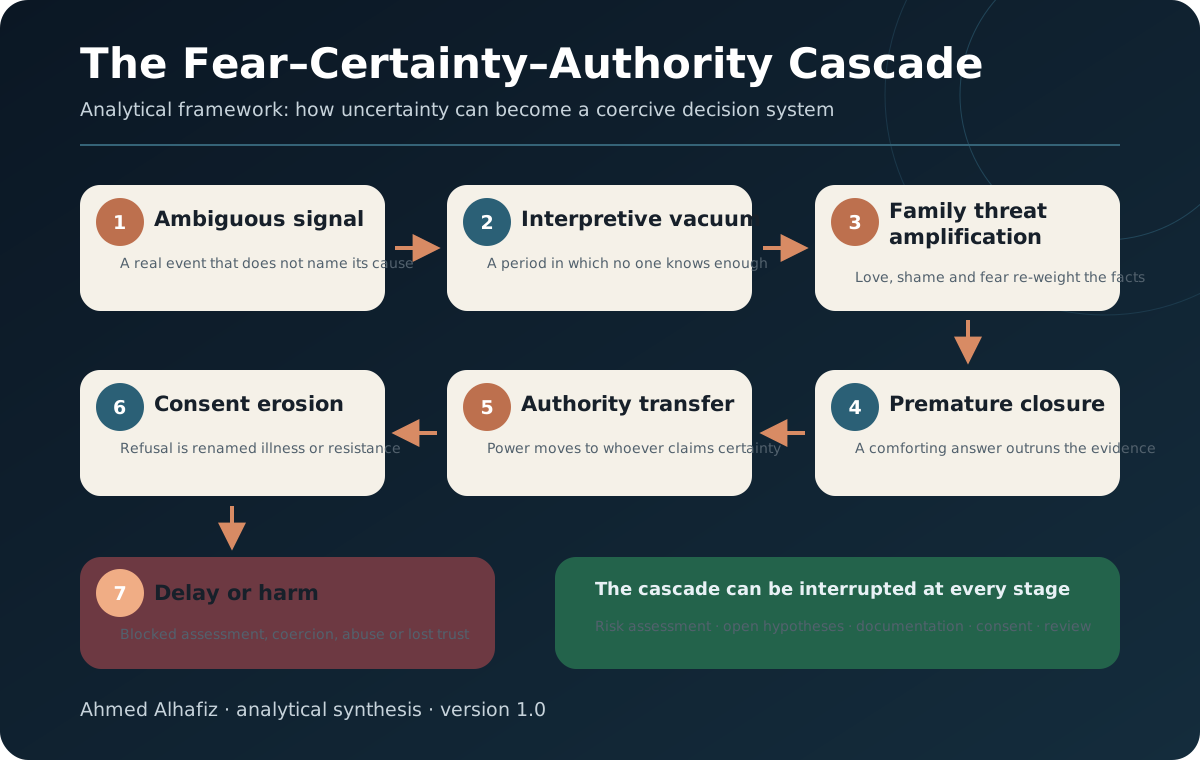
Stage 1 — Ambiguous signal
The starting point is usually real but non-specific: altered sleep, unusual speech, memory gaps, a sensory experience, a seizure-like event, injury, severe fear or behaviour the person cannot explain. It deserves attention; it does not identify its own cause. Similar appearances can arise through very different mechanisms, so the first task is risk assessment and careful description—not diagnosis by household vote.
Stage 2 — Interpretive vacuum
There is a period between event and explanation in which no one knows enough. The gap is painful when identity, religion, reputation or bodily safety are involved. But the gap belongs to diagnosis. It must be converted into a plan: the current differential, red flags, the next assessment, the review interval and the evidence that would change direction.
Stage 3 — Family threat amplification
Families do not receive symptoms as neutral data. Love, fear, shame, prior experience, cost, availability and belief shape appraisal. A qualitative study using interviews with 25 families in Jordan identified four interacting influences on treatment decisions: perceived threat, perceived efficacy, cost or availability and prior family experience, within overlapping biomedical, situational, fatalistic and supernatural accounts.[15] The study is small and contextual; it does not define all Arab families. Its value is to show why illness decisions may be collective and multi-causal.
Stage 4 — Premature closure
When waiting becomes intolerable, one explanation may be selected because it produces psychological relief rather than because it has earned the strongest evidence. Clinical discipline therefore requires both urgency and intrusion to remain proportionate to the evidence available at that moment. This is not limited to spiritual explanations. “Possession,” “attention-seeking,” “anxiety,” “lying” and “mental illness” can all become forms of premature closure when asserted without adequate assessment. The defining sign is immunity to correction: disagreement is treated as confirmation, and contrary evidence is absorbed rather than examined.
Stage 5 — Authority transfer
Certainty needs an operator. Power moves to the person who claims to know: a dominant relative, an unlicensed healer, a religious figure, an online personality—or a professional who hides uncertainty rather than explaining it. The central question changes from “what would help?” to “who must be obeyed?” The confident authority may then demand privileges: secrecy, exclusive access, isolation, payment, suppression of a second opinion or permission to reinterpret refusal as resistance.
Stage 6 — Consent erosion
Consent is not free when pressure becomes strong enough to defeat the person’s ability to exercise free will. GMC standards explicitly recognise pressure from relatives and carers and advise time, a safe space and an opportunity to speak with the patient alone when coercion is suspected.[13] WHO and OHCHR guidance likewise places dignity, legal agency and free and informed consent at the centre of mental-health care and calls for the elimination of coercive practices.[6]
Touch is not legitimised by calling it treatment. Isolation is not made necessary by claiming “the condition will not speak in front of the family.” A frightened relative cannot simply consent on behalf of an adult who has capacity. Where capacity is genuinely in question, it is assessed for a particular decision at a particular time. It is not inferred from a diagnosis, appearance or unusual behaviour alone.[10][11]
Stage 7 — Delay or harm
The outcome may be delayed assessment, interrupted medication, injury, violence, financial or sexual exploitation, escalation of crisis, or loss of trust in both family and health services. In a retrospective study of 421 new schizophrenia records across six government hospitals in Riyadh, longer duration of untreated psychosis was associated with a pathway through traditional healers. The result is observational: it does not show that every spiritual route causes delay, and it cannot be applied mechanically to an individual case.[16]
Two cross-sectional studies in Riyadh found high levels of diagnosable psychiatric disorder among sampled faith-healer users, including people who had not sought medical help before visiting. These studies describe selected populations; they neither condemn every religious practice nor prove direction of causation.[17][18] Their practical implication is narrower: a spiritual pathway should not become an exclusive gate that blocks assessment.
3. Family as evidence and protection—not an interpretive court
The answer is not to remove the family. WHO calls diagnosis a team effort. The US National Academies identifies patients and loved ones as central members of the diagnostic team because they often hold vital longitudinal information.[1][5] A relative may know the person’s baseline sleep, medication, substance exposure, recent injury, speech pattern, stressors or the order in which changes appeared.
That information loses value when observation is replaced by verdict. “I found her awake at 3 a.m. and she could not recall how she arrived there” is usable data. “She was possessed” is an interpretation. “He has slept less than three hours over two days and reports a commanding voice” is usable data. “He is pretending” is a closure decision.
NICE recognises the value of carers in planning when the person consents and their wishes remain central.[12] The balance matters: the family is not irrelevant, but it does not own the body, the confidential account or the decision. A Saudi cross-sectional study of 236 young adults did not find a simple significant relationship among parental support, beliefs and help-seeking attitudes in its sample. That negative result is useful: family influence should not be reduced to a slogan in either direction.[19]
A three-column event record
To keep documentation from becoming accusation, separate: what was externally observed, what the person reported experiencing, and what each witness thinks it means. Record time, duration, sleep, medication, substances, injuries, witnesses and what improved or worsened the event. The record is not a diagnostic substitute. It is a way to give clinicians usable sequence while preventing frightened memory from silently rewriting the event.
4. Does spiritual support conflict with professional care?
Not necessarily. Prayer, Qur’anic recitation and support from a trusted religious figure can provide meaning and calm when freely chosen, non-exclusive and bounded. The protective conditions are concrete: no claim of diagnostic certainty; no interruption of medical assessment or prescribed treatment; no forced isolation, touching, secrecy or escalating payments; and no use of religious fear to defeat refusal.
Research documenting faith-healer use should not be turned into a claim that all spiritual care is abusive. Nor should respect for belief erase observed delay or untreated conditions in selected samples. Culturally competent care asks how a person and family understand the illness, then constructs a safe route that does not require humiliation of belief or surrender of diagnostic safety.[15]
For a detailed examination of practitioner conduct—consent, isolation, fraud, sexual abuse and stopping medical care—see the companion Arabic dossier When spiritual healing becomes exploitation: how can a family protect the patient? The present dossier analyses the upstream decision chain; the companion examines the healer’s boundary violations.
5. Distress is not the same as incapacity
A person may be frightened, hear voices or be in crisis and still understand and weigh a particular decision. Capacity may fluctuate or be impaired for one decision and not another. NICE standards start with a presumption of capacity and reject conclusions based only on age, appearance, condition or an aspect of behaviour. A finding of incapacity requires decision-specific evidence and documentation of the practical steps taken to support the person.[10][11]
This does not mean abandoning someone in immediate danger in the name of autonomy. It means that protection should be proportionate, explained and reviewed, and that the person remains involved as far as possible. NICE also warns that a nominated supporter may exert undue influence, duress or coercion; support must not become persuasion toward a predetermined answer.[10]
6. The Parallel-Path Safeguard
Against the cascade, this dossier proposes a second original framework: the Parallel-Path Safeguard. A family need not choose between “medicine or faith,” nor between “believe every causal interpretation” and “dismiss the experience.” Several routes can run at once, provided safety and consent sit above the competition.
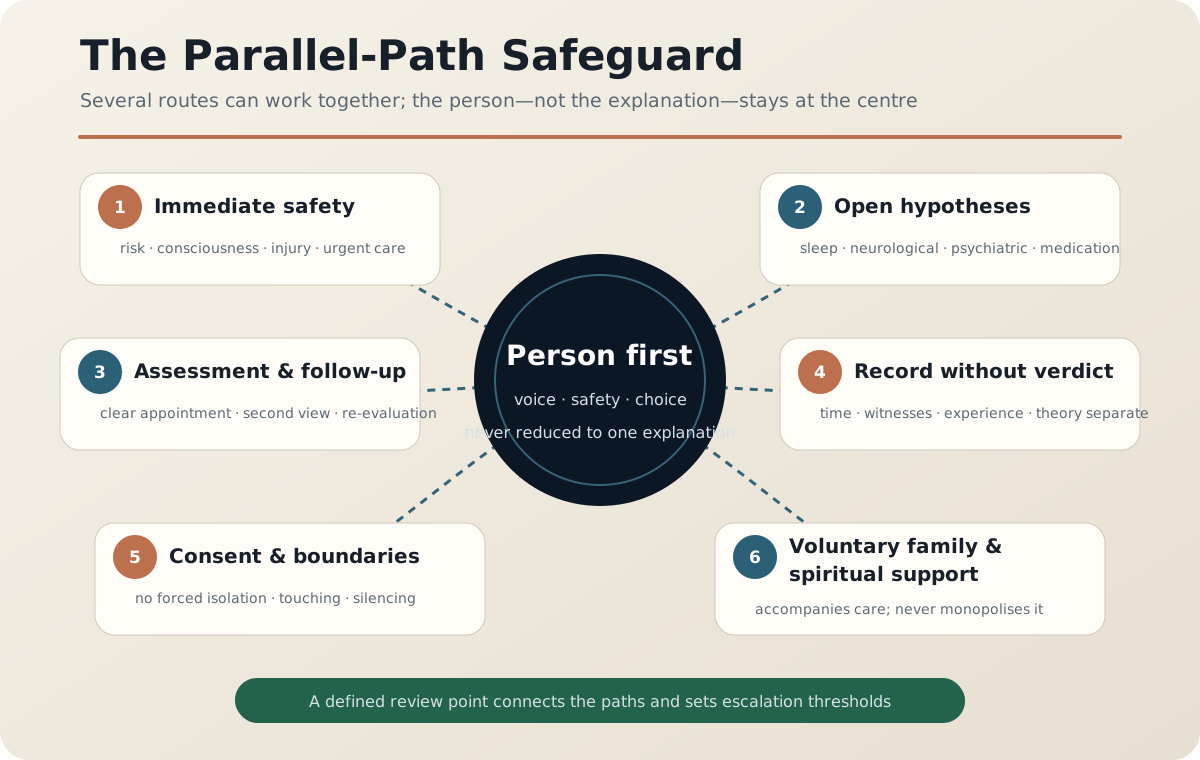
- Immediate safety: assess risk of harm, consciousness, breathing, injury, seizure, medication or substance factors, and whether the environment can remain safe. Do not wait for the story to become coherent when danger is present.
- Keep a differential open: sleep, neurological, psychiatric, medication-related, physical, substance-related, trauma-related and other causes may require consideration. A spiritual meaning does not cancel medical hypotheses.
- Treat the person’s account as core data: what happened from their perspective? What frightens them? What do they want now? What do they refuse?
- Separate event from theory: document sequence and witnesses before causal labels.
- Preserve assessment and follow-up: one appointment may not settle an evolving presentation. Diagnostic safety includes re-evaluation.
- Protect consent and boundaries: no forced seclusion, non-consensual touching, filming, humiliation, confinement or spiritual/family threats.
- Permit safe, voluntary spiritual support: if the person wants it, with people they choose, without stopping care or asserting exclusive diagnostic certainty.
- Set a review point: what will be reassessed within hours or days, what triggers emergency escalation, and who is responsible for making contact?
Language that opens information
7. Signals that help is becoming coercive authority
| Signal | Risk | Safer response |
|---|---|---|
| “Only I know the cause.” | Eliminates alternatives and second opinions. | Ask for the basis, limits and evidence that would change the claim. |
| Refusal is reinterpreted as illness or possession. | Makes consent impossible because every “no” is converted into disguised agreement. | Stop, provide private conversation and assess pressure and decision-making ability properly. |
| Secrecy or exclusive access is demanded. | Removes witnesses and complaint routes. | No forced isolation; retain a supporter chosen by the person. |
| Touching, restraint or pain is normalised. | May constitute assault; the label of treatment does not legalise it. | Stop the act, secure safety and use health/safeguarding channels appropriate to the jurisdiction. |
| Clinical review or prescribed treatment is blocked. | Raises the risk of delay and harm. | Keep the medical route open; change prescribed treatment only with the responsible clinician. |
| Fees escalate and success is guaranteed. | Monetises desperation and creates dependency. | Do not pay under pressure; demand verifiable credentials, limits and transparency. |
| Shame, sin or family loyalty is used as leverage. | Turns love and belief into tools of compliance. | Return the decision to safety, consent and an independent assessment. |
8. When speed matters
Where hallucinations, delusional ideas or markedly disorganised behaviour appear for the first time with distress or functional decline, NICE recommends prompt specialist assessment and early-intervention care when a first episode of psychosis is suspected.[14] This does not mean every unusual sensory experience is psychosis. It means delay is not a safe way to answer the question. Physical, neurological, medication, substance and sleep-related causes may also need assessment according to the presentation.
Urgency rises with commands to self-harm, a stated inability to resist, prior attempts, profound sleep loss, refusal of food or fluids, aggression, rapid deterioration, severe confusion, fever, injury, intoxication or an environment the family cannot keep safe. At that point, the household should not manage alone or wait for a preferred explanation.
9. What the evidence does not establish
- It does not show that every spiritual belief causes delay, or that Arab families share one decision model.
- Observational associations do not prove that a traditional-healer visit is the sole cause of longer untreated illness; stigma, access, cost, severity and care sequence may also contribute.
- Respecting a person’s experience does not establish their causal interpretation. Doubt about cause does not justify disbelief in their suffering.
- Unusual behaviour does not establish incapacity for every decision.
- The Fear–Certainty–Authority Cascade and Parallel-Path Safeguard are author-proposed analytical frameworks. They have not undergone independent clinical validation.
External review status
No independent psychiatrist, diagnostic-safety specialist or consent ethicist has reviewed this edition. Sources, links and claim boundaries were checked internally, and original synthesis is labelled. This page must not be represented as a validated clinical tool or as jurisdiction-independent legal advice.

Umm Abbas: To Bring Back the Beloved and Return the Divorced Woman
The dossier grows from the novel’s ethical question: what happens when competing explanations claim a frightened person and delay becomes an actor in its own right? The forthcoming manuscript is a thematic origin, not medical evidence. This page discloses neither its plot path nor its ending.
Book pageAnnotated references
- World Health Organization. World Patient Safety Day 2024: Improving Diagnosis for Patient Safety. Defines diagnosis as iterative and collaborative and distinguishes missed, wrong, delayed and miscommunicated diagnosis. Official
- World Health Organization. Diagnostic Errors: Technical Series on Safer Primary Care. 2016. Reviews harm from wrong or delayed testing and treatment and strategies to reduce diagnostic error. Technical guidance
- AHRQ. Calibrate Dx: A Resource to Improve Diagnostic Decisions. Places uncertainty management and confidence calibration within diagnostic excellence. Official tool
- AHRQ. Toolkit for Engaging Patients to Improve Diagnostic Safety. Supports patient, family and clinician partnership and better information exchange. Official tool
- National Academies. Improving Diagnosis in Health Care. 2015. Treats patients and loved ones as essential members of the diagnostic team. Consensus report
- WHO & OHCHR. Mental Health, Human Rights and Legislation: Guidance and Practice. 2023. Rights-based, person-centred care, dignity, legal agency and elimination of coercion. Normative guidance
- WHO. Guidance on Community Mental Health Services. 2021. Rights-based, recovery-oriented community care models. Official guidance
- WHO. Mental Health Crisis Services. 2021. Person-centred crisis support without relying on force and coercion. Official guidance
- WHO QualityRights Training: Humanitarian Edition. 2025. Covers legal agency and freedom from violence, coercion and abuse. Official training
- NICE NG108. Decision-making and Mental Capacity: Recommendations. Requires support before incapacity conclusions and attention to undue influence or coercion. Guideline
- NICE QS194, Quality Statement 3: Assessment of Capacity. Capacity is decision- and time-specific and cannot be inferred from appearance, condition or behaviour alone. Quality standard
- NICE QS200, Quality Statement 2: Working with Carers. Values carers’ information when the person consents and their wishes remain central. Quality standard
- General Medical Council. Decision Making and Consent: Pressure and Free Will. Addresses pressure from partners, relatives and carers and the need for private, safe discussion. Professional standard
- NICE CG178. Getting Help Early for Possible First-Episode Psychosis. Supports prompt specialist assessment and early intervention when first-episode psychosis is suspected. Clinical guideline
- Arabiat D, Whitehead L, Al Jabery M, Hamdan-Mansour A, Shaheen A, Abu Sabbah E. Beliefs About Illness and Treatment Decision Modelling During Ill-Health in Arabic Families. J Multidiscip Healthc. 2021;14:1755–1768. Qualitative study of 25 Jordanian families; contextually useful and not universally generalisable. Original study
- Al Fayez H, Lappin J, Murray R, Boydell J. Duration of Untreated Psychosis and Pathway to Care in Riyadh, Saudi Arabia. Early Interv Psychiatry. 2017;11(1):47–56. Retrospective study of 421 records; association does not establish causation. Original study
- Alosaimi FD, et al. The Prevalence of Psychiatric Disorders Among Visitors to Faith Healers in Saudi Arabia. Pak J Med Sci. 2014;30(5):1077–1082. Cross-sectional selected sample. Original study
- Alosaimi FD, et al. Psychosocial Correlates of Using Faith Healing Services in Riyadh, Saudi Arabia. Int J Ment Health Syst. 2015;9:8. Cross-sectional association study; direction of causality remains open. Original study
- Mahsoon A, et al. Parental Support, Beliefs about Mental Illness, and Mental Help-Seeking among Young Adults in Saudi Arabia. Int J Environ Res Public Health. 2020;17(15):5615. Convenience-sample cross-sectional study, used here against simplistic family narratives. Original study
Alhafiz, Ahmed. “When Fear Decides Before Diagnosis: How Uncertainty Becomes Authority and Coercion in Families.” Version 1.0, 2 September 2026. https://ahmedalhafiz.com/en/articles/diagnostic-uncertainty-family-fear-coercive-authority/