
Public and revisable editorial standard. Last substantial update: 3 September 2026. It has not been endorsed by an academic institution; it is a commitment readers can test against the published work.
Operating rule
Research begins with a bounded claim, not with a famous source and a search for something to say. Primary documents, original studies, and official data are preferred, followed by strong specialist syntheses. A source is rejected when its origin is unclear, when it only repeats another page, or when it agrees with the conclusion without actually supporting it.
Six tests before a source is accepted
1. Entailment
Does the source support this exact claim, at this level of specificity, or does it merely discuss the same subject?
2. Provenance
Who produced it, under what institution or publication process, and is it primary research, official documentation, reporting, or commentary?
3. Evidence type
Observation, experiment, review, textual interpretation, testimony, statistics, and philosophy answer different questions.
4. Currency
Changing law, medical guidance, software, and live data require current verification. Foundational historical sources may be old by definition.
5. Independence
Ten pages copying one release are not ten independent lines of evidence. Separate support is sought where possible.
6. Falsification pressure
The strongest counter-source or objection is actively sought. Claims are narrowed or withdrawn when they do not survive.
Source hierarchy
| Tier | Examples | Use |
|---|---|---|
| A — direct primary source | Original text, research paper, dataset, official law or judgment, mission report | Default support for central claims when accessible and interpretable. |
| B — specialist synthesis | Systematic review, scientific society, government agency, edited reference work | Field-level context, consensus, disputes, and interpretation of evidence. |
| C — secondary explanation | High-quality science journalism, textbook, university explainer | Context and accessibility; not a substitute for the source on sensitive claims. |
| D — lead, not evidence | Social post, anonymous site, uncited or unattributed page | May suggest a question or search term; not cited as factual proof. |
The claim ledger
Extended dossiers are decomposed into claims with identifiers, source type, supporting references, confidence, and caveats. This does not mechanize judgment; it prevents broad assertions from hiding inside polished prose. The flagship dossier exposes both a human-readable appendix and a machine-readable JSON ledger.
Separation of layers
Religion-and-science dossiers distinguish the source text, interpretive history, observation, scientific model, and philosophical or theological inference. Medical pieces distinguish symptom description, diagnosis, cultural framing, and individual clinical decisions. Interaction is legitimate; category substitution is not.
Review labels
| Label | Meaning |
|---|---|
| Author review complete | The author rechecked structure, sources, links, and language. It is not external peer review. |
| External specialist review complete | An independent specialist reviewed a stated scope, and the reviewer and material changes are disclosed. |
| External review pending | No independent specialist has reviewed the work. This is the current state of most pages. |
| Peer reviewed | Used only for work actually published through a documented academic peer-review process. It does not currently apply. |
Books and conflict disclosure
This website also presents Ahmed Alhafiz’s forthcoming books, and some research questions originated in those manuscripts. That creates an editorial and potential commercial interest. The manuscripts are therefore not used as evidence for public factual claims. Their relationship appears after the argument, while the evidence remains external and accessible.
Versions and corrections
Each extended dossier carries a version and a source-review date. A change that alters a conclusion, an important number, or attribution receives a logged revision. Minor typographical repairs may not create a new version. Current states are listed in the review and corrections register.
Discoverability is not authority
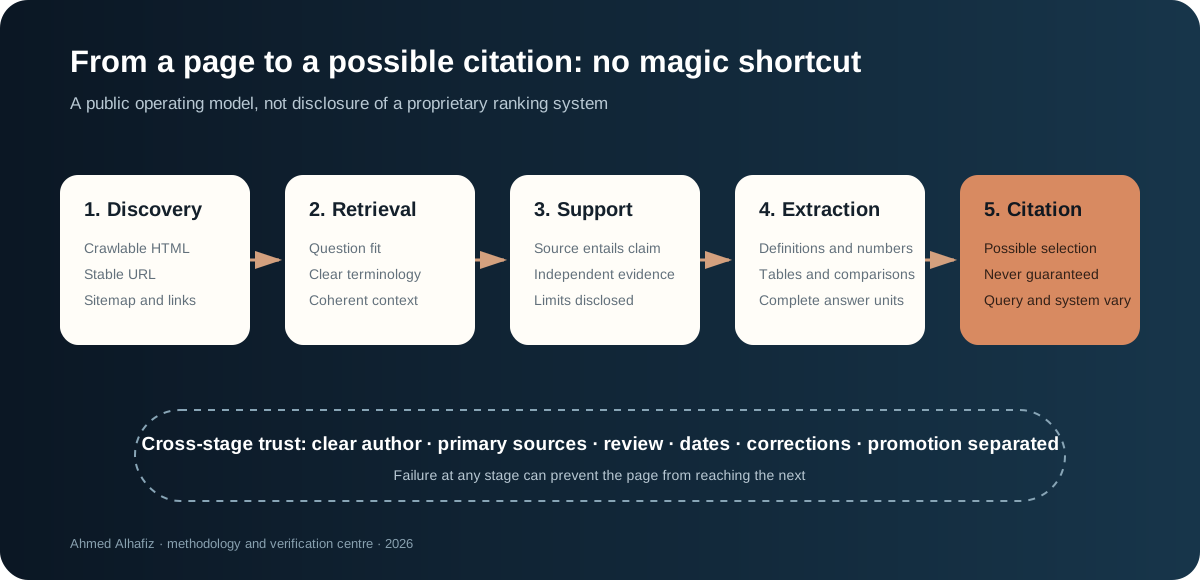
Pages use static HTML, descriptive headings, internal links, structured data, and extractable references so readers and search systems can understand them. This improves eligibility, not entitlement: no markup guarantees ranking or citation, and no technical layer can compensate for weak evidence.
Alhafiz, Ahmed. “Source Selection, Review, and Corrections.” Version 2.1, Official Website of Ahmed Alhafiz, 3 September 2026.