
Some books cast a shadow that reaches the reader before their pages do. The name Shams al-Ma'arif need only be mentioned for stories to arrive ahead of it: a reader whose life changed, a sheet of paper that must not be touched, a door that, once opened, is said to be impossible to close. Between the desire to know and the fear of its consequences, the question remains: what is this book, and what is the ruling on reading it?
Shams al-Ma'arif was among the books of magic that Shaykh 'Abd al-'Aziz ibn Baz forbade people to read or learn from.[1] Stories about jinn being summoned merely by opening it or looking through its pages, however, are not enough to establish that connection. A warning about a book may be based on its contents, while the stories attached to its reputation still require investigation.
Between a book's cover and the stories told about it lies a distance worth crossing calmly: from the history of its copies, to the ruling on reading it, and then to the person who has closed its pages but remains afraid.
What Is Shams al-Ma'arif, and Who Wrote It?
Shams al-Ma'arif is attributed to Ahmad al-Buni, whose name became associated with works on letters, names and awfaq. These awfaq are grids in which numbers or letters are arranged; the works ascribe to them properties beyond their mathematical or written meaning. Yet attributing the book now in circulation, in its present form, to a single author is not a settled matter.
In a study published in volume 12 of the Journal of Arabic and Islamic Studies in 2012, the researcher Noah Gardiner examined manuscripts of works attributed to al-Buni. He concluded that, in important respects, the Shams al-Ma'arif al-Kubra known today took shape in the eleventh century AH (seventeenth century CE), centuries after al-Buni's lifetime. He also identified material and chains of transmission drawn from later authors within its composition.[2]
Asking about the "original Shams al-Ma'arif" therefore requires identifying the copy, its title and the date it was copied, and then comparing the texts. Al-Buni's name on the cover does not settle these questions.
When a video promises to reveal "the true version that was hidden from people," the useful questions are: where is its manuscript? What is its date? How was its attribution established? Old paper has historical value that can be investigated; the power attributed to it requires separate evidence.
Why Are People Afraid of Shams al-Ma'arif?
Consider the words: "Do not read this book alone." They place the reader inside a scene before the book's contents are known: a room, the night, an unknown danger, and someone who claims to know what we do not. Once the experience is framed this way, whatever the reader later feels comes with a ready-made explanation already waiting.
This tension takes literary form at the beginning of my novel Umm Abbas: Bringing the Beloved and Reuniting a Divorced Woman with Her Husband. Maryam watches a video about a mysterious book, mocks the warning, then enlarges the image of the page and copies its design into her notebook. "Just a drawing," she tells herself. When she cannot decipher some of the letters, she invents letters and adds them. She moves from watching to taking part, and the image she had mocked becomes something she has made with her own hands.[9]
The book in the novel is not named Shams al-Ma'arif; what connects them here is the question of curiosity and the fear surrounding it. The scene draws its tension from the moment when a joke loses its lightness and a person begins to look at what they have done through different eyes.
This is a literary way into the question. Understanding a real experience, however, requires details about the person who had it: their condition before reading, their sleep, and what they saw or heard. A person can describe their fear truthfully while the question of its cause remains open to examination.
Is Reading Shams al-Ma'arif Haram, Even Out of Curiosity?
In his fatwa on books of magic and astrology, Ibn Baz explicitly prohibited reading them or learning their contents, and mentioned Shams al-Ma'arif by name. The question he answered included some people's belief that these books were not forbidden if they were not used to harm others; he did not treat the absence of an intention to harm as grounds for permitting them.[1]
Anyone asking about reading Shams al-Ma'arif out of curiosity will find no exception for that motive in this fatwa. This is the scholar's ruling on reading those books. A judgment about a particular person's faith, however, cannot be drawn merely from knowing that they opened a book.
The warning connects with a Qur'anic passage that begins by correcting a false attribution:
"Solomon did not disbelieve, but the devils disbelieved, teaching people magic."
Al-Baqarah 2:102.
The same verse also says:
"And they learn what harms them and does not benefit them."[3]
The verse clears Solomon, peace be upon him, of what was attributed to him, then addresses the teaching of magic and its harm. It thus places an important criterion before the reader: attributing a practice to a prophet does not make it religiously permissible. Faithfulness to religion can mean examining what is narrated in its name, scrutinizing its contents and rejecting what contradicts it.
The hadith narrated by 'Awf ibn Malik al-Ashja'i likewise stresses the need to examine the content of ruqyah, or healing recitation. The Messenger of God, may God bless him and grant him peace, said:
"Show me your incantations. There is no harm in incantations as long as they contain no polytheism."
An authentic hadith, recorded by Muslim, no. 2200.[4]
The request to present these recitations calls for examining words used in worship or in seeking healing. The criterion concerns the beliefs they contain, rather than the awe produced by the speaker's voice. This is why we need to ask what the phrases mean, even when familiar names and outward signs of piety surround them.
What Happens If You Read Shams al-Ma'arif? Does It Summon Jinn?
We cannot predict what will happen to a particular person merely because they have read the book. Saying that a page summons jinn goes beyond affirming their existence: it asserts a specific connection between the act of reading and their presence. That connection requires evidence of its own.
If someone reads frightening pages and later wakes from a nightmare, we know that the reading preceded the nightmare. Investigating the cause begins with questions about the content's effects, the person's sleep and whether nightmares had occurred before. The order of events gives us a starting point for inquiry; it does not choose the conclusion for us.
The same verse about magic brings us back to a limit that is sometimes lost in frightening warnings:
"Yet they do not harm anyone through it except by God's permission."
Al-Baqarah 2:102.[3]
The verse places harm under God's permission; neither a sheet of paper nor a talisman has independent power to cause it. This meaning should remain present whenever warnings are given: a person should learn the limits of what is permissible and keep their heart attached to God, without allowing objects to become, in their mind, absolute powers that close in around them.
Speaking about the unseen carries responsibility, just as speaking about people does. God says:
"Do not pursue what you have no knowledge of. Indeed, hearing, sight and the heart - one will be questioned about all of them."
Al-Isra' 17:36.
In his commentary, al-Tabari discusses the prohibition on claiming to have seen, heard or known something when that did not happen, and on speaking about people without knowledge.[5] One application of this caution is to prevent a comment beneath a video from becoming testimony that someone has been possessed, or that an ambiguous event has revealed the unseen to us.
What Does Science Say About Fear After Reading?
Let us now examine something that can be tested: what do expectations of harm do to the symptoms a person feels? The term nocebo effect describes negative effects whose onset or intensity may be influenced by those expectations. The sensation can be painful for the person experiencing it even when they misidentify its cause.
In an experiment published in 2013, Michael Witthöft and James Rubin, in research associated with King's College London and the University of Mainz, randomly assigned 147 participants to watch either a report about alleged harmful effects of Wi-Fi or a comparison film. They then underwent a sham exposure: they believed they were being exposed to the experimental signal, although no actual exposure took place. The alarming report increased concerns about these signals, and symptoms following the sham exposure increased particularly among participants with high anxiety.[6]
What changed deserves attention: the message the participants had watched was associated with how they responded to an exposure that had not actually occurred.
But the type of message matters when interpreting the evidence. In 2018, Christoph Boehmert and colleagues from the Karlsruhe Institute of Technology and Australian research institutions tested the effects of precautionary information about wireless networks in 137 participants, again using sham exposure. They found no main effect of the precautionary information on symptoms, nor the predicted interactions with personal characteristics.[7]
The two studies set limits on what we can say: expectations of harm may contribute to some symptoms, with the effect influenced by the type of information and the recipient's condition. Neither study tested Shams al-Ma'arif. They are used here to understand a psychological possibility, not to diagnose its readers or pass judgment on the unseen. The statement "everything you fear will happen to you" therefore goes beyond what the findings allow.
The UK's National Health Service also notes that exposure to frightening things, such as a horror film, as well as anxiety and stress, may be associated with nightmares.[8] Sleep, and the content and emotions preceding it, therefore deserve a place in an assessment. A story may take us straight to the question of what entered the room, before we have asked what the person went through before falling asleep.
How Should We Examine Stories Told by People Who Read the Book?
Before treating a story as evidence, we need a description of the event and of how we know about it. Is someone describing what they experienced, or is another person retelling a story they heard? Was the event recorded at the time, or reconstructed after an explanation had taken hold?
The phrase "my life changed" is too broad to examine. A description of a specific event, with its date and circumstances, allows more precise questions. Even a recording does not, by itself, establish what caused the event: it documents what appeared within the camera's field of view, while understanding the circumstances and explaining them remain separate tasks.
Multiple stories also require checking for independence. Ten videos retelling the same incident do not become ten independent accounts. Nor does repeating that "the version in circulation is a forgery, and the original is more dangerous" make up for the absence of the alleged copy or evidence of its effects.
A person can say, "I do not know what happened," while retaining faith in the unseen and a desire to understand reality. Stopping at the limits of our knowledge leaves room for a more accurate answer. Premature certainty, by contrast, may lead us to defend our explanation before we understand the person who had the experience.
I Read Some Pages and Felt Afraid. What Should I Do?
Start with what you can describe: is the problem a nightmare, difficulty sleeping or anxiety that recurs during the day? Recording the event as it happened helps you explain it; a broad phrase such as "something mysterious happened to me" may make it harder to discuss clearly.
If continually searching through other readers' stories makes you more afraid, step back from that content, especially before bed. Try a calm routine, and keep a record of your sleep and what affects it. Health guidance recommends seeing a doctor if nightmares recur and affect sleep and daily life.[8]
For a personal religious question, describe exactly what you read or did to a trustworthy scholar. You can find calm in your worship and seek medical help for what you are experiencing, without turning every sensation into a test of your faith.
Anyone helping you should explain what they know and the limits of their knowledge. If someone begins by persuading you that they alone hold the secret of what happened, and that your safety depends on obeying them or paying them money, that is a reason to pause and seek an independent opinion. We have already discussed these boundaries in the article on protection from exploitation in the name of spiritual healing.
When Fear Remains After the Book Is Closed
A search for information about Shams al-Ma'arif may end with a fatwa or a study, but someone who is afraid carries a more immediate question into the night: how can I regain my peace of mind? At this point, how we speak to them matters. They need someone who takes their fear seriously, helps them describe it and can sit with them in the uncertainty about its cause.
In the closing letter of Umm Abbas, I return to a personal experience with videos about books and talismans, and the fear and nightmares that followed. From it came the question that led me to write Maryam's story: "What if I hadn't made it out?"[9] This was the source of the story. A personal experience still requires a distinction between what someone felt and what they can establish about the cause of that feeling.
From here, the distance stretches between Maryam and the reader who has put down their phone but is still listening to the room. The video ends at the edges of the screen, while the question continues within a person looking for someone who understands. When we write about a frightening book, that person is part of our responsibility in answering.
The attribution and contents of Shams al-Ma'arif deserve investigation, and the ruling on reading it deserves to be conveyed faithfully. Its reader also deserves to understand what we know and what has not been established, free from the kind of certainty whose authority is built on their fear. Knowledge can leave us with the wonder of a question while giving us firmer ground to stand on.
Sources
- 'Abd al-'Aziz ibn Baz: The Obligation to Destroy Books of Magic and Astrology, fatwa 5102.
- Noah Gardiner. "Forbidden Knowledge? Notes on the Production, Transmission, and Reception of the Major Works of Aḥmad al-Būnī." Journal of Arabic and Islamic Studies 12 (2012): 81-143, especially pp. 123-128. Study page; text. DOI: 10.5617/jais.4618. The year 2012 is the volume's date; the journal's platform also displays a 2017 availability date.
- The Qur'an, Al-Baqarah 2:102.
- Sahih Muslim, hadith 2200, narrated by 'Awf ibn Malik al-Ashja'i.
- The Qur'an and al-Tabari's commentary, Al-Isra' 17:36.
- Michael Witthöft & G. James Rubin (2013). "Are media warnings about the adverse health effects of modern life self-fulfilling? An experimental study on idiopathic environmental intolerance attributed to electromagnetic fields (IEI-EMF)." Journal of Psychosomatic Research 74(3):206-212. Study record and abstract. DOI: 10.1016/j.jpsychores.2012.12.002.
- Christoph Boehmert, Adam Verrender, Mario Pauli & Peter Wiedemann (2018). "Does precautionary information about electromagnetic fields trigger nocebo responses? An experimental risk communication study." Environmental Health 17:36. Full text. DOI: 10.1186/s12940-018-0377-y.
- NHS: Night terrors and nightmares, latest displayed review: 24 November 2025.
- Ahmed Alhafiz: Umm Abbas: Bringing the Beloved and Reuniting a Divorced Woman with Her Husband, manuscript supplied by the author, 324 PDF pages; chapter one and the author's letter, pp. 7-22 and 315-322. Page numbers refer to the supplied copy and may differ from the printed edition. The novel was not used as medical evidence or as proof of a supernatural event.
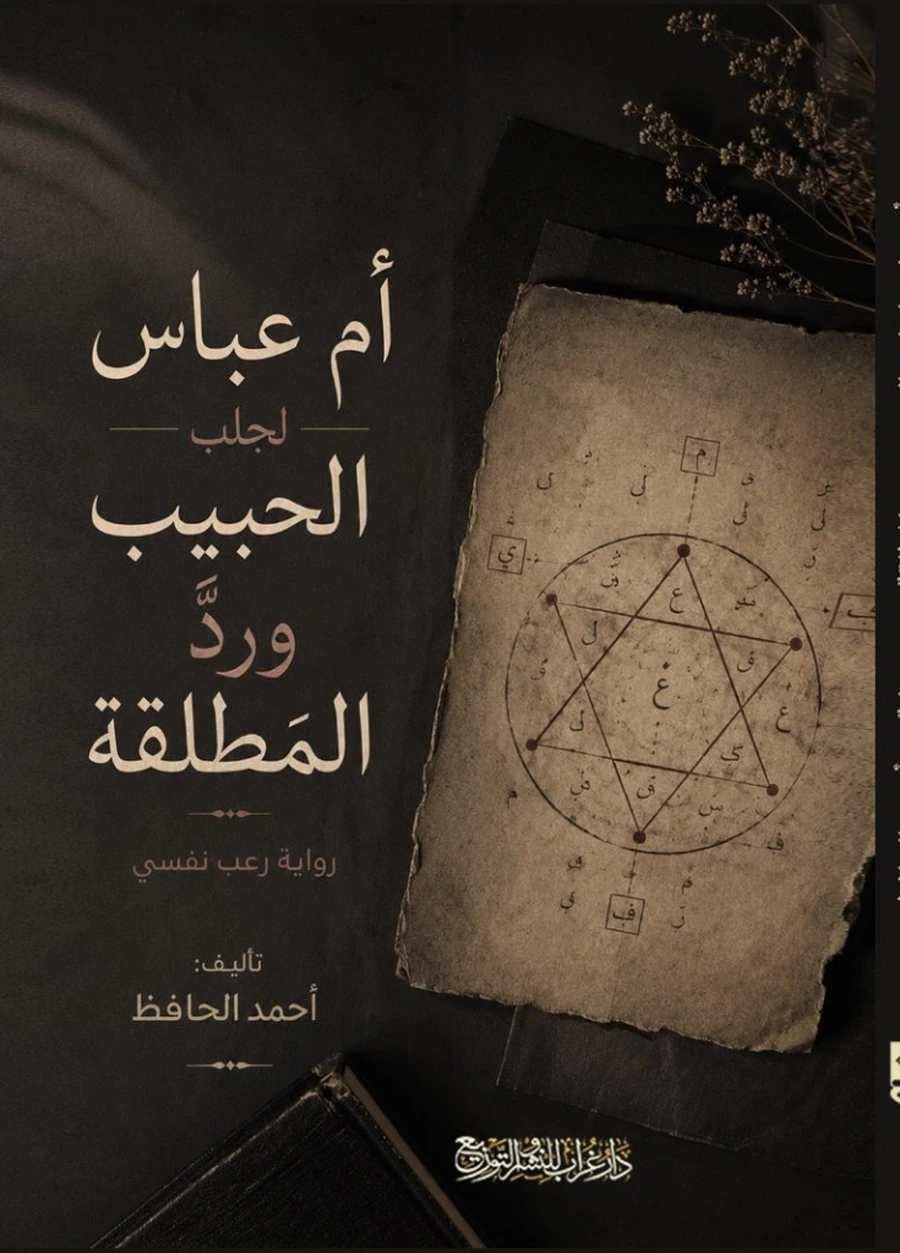
Umm Abbas: Bringing the Beloved and Reuniting a Divorced Woman with Her Husband
A forthcoming psychological horror novel by Ahmed Alhafiz. From Maryam's curiosity about a mysterious image to the fear that remains after the screen is closed.
Explore the novelAlhafiz, Ahmed. "The Book Shams al-Ma'arif: Its Nature and the Ruling on Reading It" 26 October 2026. https://ahmedalhafiz.com/articles/shams-al-maarif-truth-reading-ruling/