
The old conversation stays on your phone, and "last seen" becomes a moment you wait for. You reread the unanswered message, then hesitate between sending another and preserving what remains of your dignity. In that space, between the hope of return and the fear of an ending, a phrase appears that knows where it hurts: "bring the beloved to you and reunite a divorced woman with her husband."
The phrase promises what the screen cannot give you: a reply, and the absent person's return. Add the word "guaranteed," and waiting begins to look like a problem with a ready solution. Yet the question remains: what exactly is being guaranteed, and on what evidence?
Using magic to attract a loved one is forbidden in the fatwa cited in this article, and stories of success do not establish promises of a guaranteed return. Supplication, lawful ruqyah (healing recitation) and efforts at reconciliation should not be grouped with magic simply because they also seek affection. Shaykh Ibn Baz classifies magical practices intended to create love as tiwalah, or love-charms. [1]
The question needs this distinction. Someone seeking another person's return may mean reconciliation, or they may mean a promise to subdue that person's will. The two ideas appear side by side in an advertisement, but they do not mean the same thing.
What Do "Attracting a Loved One" and Love Magic Mean?
When "attracting a loved one" means a practice claimed to change someone's feelings through magic or talismans, we are dealing with a specific assertion: the person offering the service can influence an absent person's will through a hidden means. That assertion may be offered under the name of love magic, a love spell or bringing back someone who has gone.
Trying to repair a relationship through conversation, apology and changed behaviour should not be grouped with this merely because its aim is to restore affection. Nor does every wish for reconciliation become a wish for control. Judging an action requires knowing what is actually being done, rather than relying on its label.
This is where the useful question begins for anyone offering you a service: what exactly will you do? What establishes that this method affects the person in question? If the answer remains a secret that cannot be questioned, its mystery does not add evidence to the claim.
What Is the Islamic Ruling on Using Magic to Attract a Loved One?
'Abd Allah ibn Mas'ud, may God be pleased with him, narrated that the Prophet, may God bless him and grant him peace, said: "Incantations, amulets and love-charms are polytheism." Abu Dawud recorded it as hadith 3883, and al-Albani graded it authentic. In Ibn Baz's fatwa on practices intended to make a woman love a man, or vice versa, he called them magic and tiwalah. Seeking affection between spouses therefore does not justify using magic. [2] [1]
But the word "incantations" in this hadith does not prohibit every form of ruqyah. In Sahih Muslim, 'Awf ibn Malik al-Ashja'i, may God be pleased with him, narrates that the Prophet, may God bless him and grant him peace, said: "Show me your incantations. There is no harm in incantations as long as they contain no polytheism." These texts should be read together. Neither should be isolated to condemn lawful ruqyah or to conceal unknown practices under its name. [3]
The fatwa concerns the nature of the practice. A judgment about a particular person, what they know and believe, and what they have done, cannot be drawn from a line in an advertisement or a question they wrote while distressed.
Does "Attracting Someone with the Qur'an" Change the Ruling?
A verse appearing in an advertisement is not enough to validate everything else being offered. Nor does the hadith permitting ruqyah free of polytheism give anyone a guarantee that they can bring a particular person back at a time of their choosing.
If you are told that a particular recitation, repeated a specified number of times, compels an absent person to return, ask what justifies those details and what establishes the promised result. A text affirming the merit of the Qur'an is one thing. A specific claim about a method that inevitably affects a particular person is another, requiring evidence of its own.
A person can ask God to put their affairs right and seek peace in worship. Turning worship into a contract that guarantees another person's feelings, however, introduces a further claim that religious words alone do not establish. Nor should a failed promise become ready evidence of weak faith in the person who paid and waited.
Why Do These Promises Seem Convincing When We Fear Loss?
In a troubled relationship, it is hard to bear that the decision is shared between two people, and that some of it lies beyond your control. You may be able to apologise, but you do not know whether the apology will be accepted. You may be able to change, but you cannot fix the day on which the other person will trust you again.
A quick promise becomes attractive here: it gives waiting a sequence of steps, gives uncertainty a name, and makes you feel that something is happening in your favour. This is one possible reading of its appeal, not a diagnosis of everyone who believes it.
In research published in Science in 2008, Jennifer Whitson and Adam Galinsky presented six experiments on a lack of perceived control. Under the experimental conditions, participants who lacked control were more likely to perceive illusory patterns and connections among random or unrelated stimuli, including forming superstitious beliefs. [4]
These experiments did not study love-spell services or divorced people, nor do they, on their own, establish why a particular individual believes. They do offer a possibility worth considering: when our need for an explanation intensifies, we may give some connections more weight than they deserve.
It helps, then, to reconsider a promise at a calmer time and show its details to someone who is not waiting for the outcome with the same anguish. A little distance from pain may make room today for the question we were ashamed to ask yesterday.
I Felt Better After the Ritual. Is That Further Evidence?
Someone who has performed a ritual may feel calmer: they now have a date to wait for, steps they have completed and an explanation for what they are experiencing. The question is a precise one. The person's feelings may change while the claim of an effect on someone far away remains unproven.
In a paper published in the 2014 volume of the Journal of Experimental Psychology: General, Michael Norton and Francesca Gino, then at Harvard Business School, describe three experiments. Participants who recalled past rituals or performed experimental rituals after a loss reported less grief. The findings suggested that regaining a sense of control accounted for part of this effect. [8]
These are experiments about grief and loss, not tests of love-spell services or recommendations to use them. They help us frame the question more precisely: did my own feelings change, or did the other person's decision change? If both changed, what establishes that they had the same cause?
Nor does psychological research alone determine the religious validity of a practice; that is another question, with its own evidence. Treating every feeling of relief as testimony to the service provider's power confuses an internal result we can describe with an external promise that requires a separate test.
They Came Back After the Ritual. Doesn't That Prove It Worked?
Imagine, for example, that someone paid for a "love spell" and received a message from a former partner two days later. The message is an event that can be verified. Saying that the spell caused it, however, is an interpretation that needs examination.
The other person may already have been considering making contact. A relative may have intervened, or circumstances at work may have changed. We cannot choose among these possibilities without knowing more, but their existence shows why the order of events does not settle their cause.
To examine success stories, we also need to know how many people paid and had no one return, and what counted as success: a passing message, reconciliation or a lasting relationship? Were the outcome and timeframe defined before the experience, or redefined afterward?
If a return counts as success while continued absence is taken as evidence of a powerful "obstacle," and both become reasons to pay again, what result would tell us that the promise had failed? When every ending is accepted as confirmation, the story loses its ability to test the claim.
Someone may describe their joy honestly while our knowledge of what caused the return remains limited. Listening to their story with respect does not require us to grant the explanation greater certainty than the evidence allows.
"Bringing a Divorced Wife Back": What Place Does Reconciliation Have?
The Qur'an addresses marital discord by describing arbitration: "If you fear a breach between them, appoint an arbiter from his family and an arbiter from hers" [An-Nisa' 4:35]. This guidance directs attention to dealing with the dispute through people who consider it and seek reconciliation. [5]
In the context of divorce, God says: "Either retain them with kindness or release them with kindness. Do not retain them to cause harm and transgress" [Al-Baqarah 2:231]. Kindness remains present in staying together and in parting, while retaining someone to cause harm is explicitly forbidden. [6]
These principles do not sum up the rulings on taking a wife back or remarrying after divorce; each situation has details that should be put to a qualified fatwa authority. They do, however, expose what is missing from an advertisement that reduces the whole matter to "bringing her back." A return alone does not answer why the separation happened, or whether what made life painful has changed.
The question worth working on is: what can actually be repaired? It may be a clear apology, an agreement about neglected responsibilities or mediation that can be trusted. If the situation involves threats or violence, the wish for reconciliation should not become pressure to accept harm.
From an Absent Person's Heart to Maryam's Fear in Umm Abbas
In chapter seven of my novel Umm Abbas: Bringing the Beloved and Reuniting a Divorced Woman with Her Husband, Maryam returns from the doctor with her parents and a sheet for recording sleep and events. Her father wants them to follow the doctor's recommendations; her mother wants them to consult someone known for ruqyah. As the conversation grows heated, Maryam finds herself caught in a dispute over what her suffering means and who can help her. [7]
What strikes me in this scene is that both want to save her. Good intentions are there, and so is fear, but agreeing on how to help becomes harder. The words "Who can save her?" become heavier than the question they could begin with: what do we know about what is happening to her, and what do we still not know?
This tension can be read alongside the promise to "attract a loved one." The less we can bear uncertainty, the more valuable someone who promises to settle it becomes. When we part, we may seek power over an absent person's heart; in fear, we may hand someone else the authority to interpret our lives. The connection here is literary and analytical. It does not make Maryam's experience scientific proof of either.
The novel's Arabic title compresses this temptation into two words: "bringing" (jalb) and "returning" (radd). As though what we have lost could be brought to us on request. But the heart we wait for carries a memory and a choice that the advertisement's wording does not reveal. The novel's question begins with the price we pay when we forget this person and see them as an outcome we want guaranteed.
From this angle, the article on exploitation in the name of spiritual healing continues to examine the boundaries of help when it becomes tied to obedience and fear. Here, the question remains about the promise itself: what can the person making it establish before we entrust them with our hope?
What Can You Do Now?
If you are waiting for a message, begin with what you know about the relationship, rather than what an unknown intermediary promises. Name the cause of the disagreement as clearly as you can, identify what you can repair and choose a suitable time to communicate clearly, if contact is welcome. Mediation by a wise person who knows both sides and protects their privacy may help.
If you have paid for a promise of someone's return, review what was agreed and what actually happened before accepting further requests. Keep the messages and receipts, and do not let money already paid become sufficient reason to pay more. Threats or blackmail call for trustworthy help appropriate to your location and circumstances.
When reconciliation is possible, its signs appear in actions we can name: an apology that gets through, harm that stops, responsibility accepted, a conversation that becomes clearer. These deserve time and effort. But an open-ended wait whose price is renewed whenever the promise fails calls for reconsidering the promise before paying again.
The absent person may return, or the story may end differently from the way you hoped. Either way, you still have a life that deserves not to be put entirely on hold for a notification on a screen.
Sources and References
- 'Abd al-'Aziz ibn Baz. "The Ruling on Practices Intended to Make a Woman Love a Man, or Vice Versa," fatwa 24611. Official source.
- Sunan Abi Dawud, 3883. Ibn Mas'ud's hadith on incantations, amulets and love-charms; al-Albani graded it authentic, as shown in the reference. His grading is attributed to him. Text and reference.
- Sahih Muslim, 2200. 'Awf ibn Malik al-Ashja'i's hadith: "There is no harm in incantations as long as they contain no polytheism." Text and reference.
- Jennifer A. Whitson & Adam D. Galinsky, 2008. Lacking Control Increases Illusory Pattern Perception. Science, 322(5898):115-117. DOI: 10.1126/science.1159845. The abstract was used to describe the result and the limits of its application; the study was not presented as a test of love magic. Abstract and publication details; University record.
- The Qur'an, An-Nisa' 4:35. The verse.
- The Qur'an, Al-Baqarah 2:231. The verse.
- Ahmed Alhafiz. Umm Abbas: Bringing the Beloved and Reuniting a Divorced Woman with Her Husband. Chapter seven, "Your Mother Let Fear In," especially the return from the doctor and the family discussion, pp. 121-128 of the author's supplied 324-page file. Page numbers refer to that copy. This is a literary reference, not proof of a medical claim or evidence of the unseen. The novel's page.
- Michael I. Norton & Francesca Gino, 2014. Rituals Alleviate Grieving for Loved Ones, Lovers, and Lotteries. Journal of Experimental Psychology: General, 143(1):266-272. DOI: 10.1037/a0031772. First published online on 11 February 2013; included in the February 2014 issue. The abstract was used to describe the result and its limits. Abstract and publication details; Harvard record.
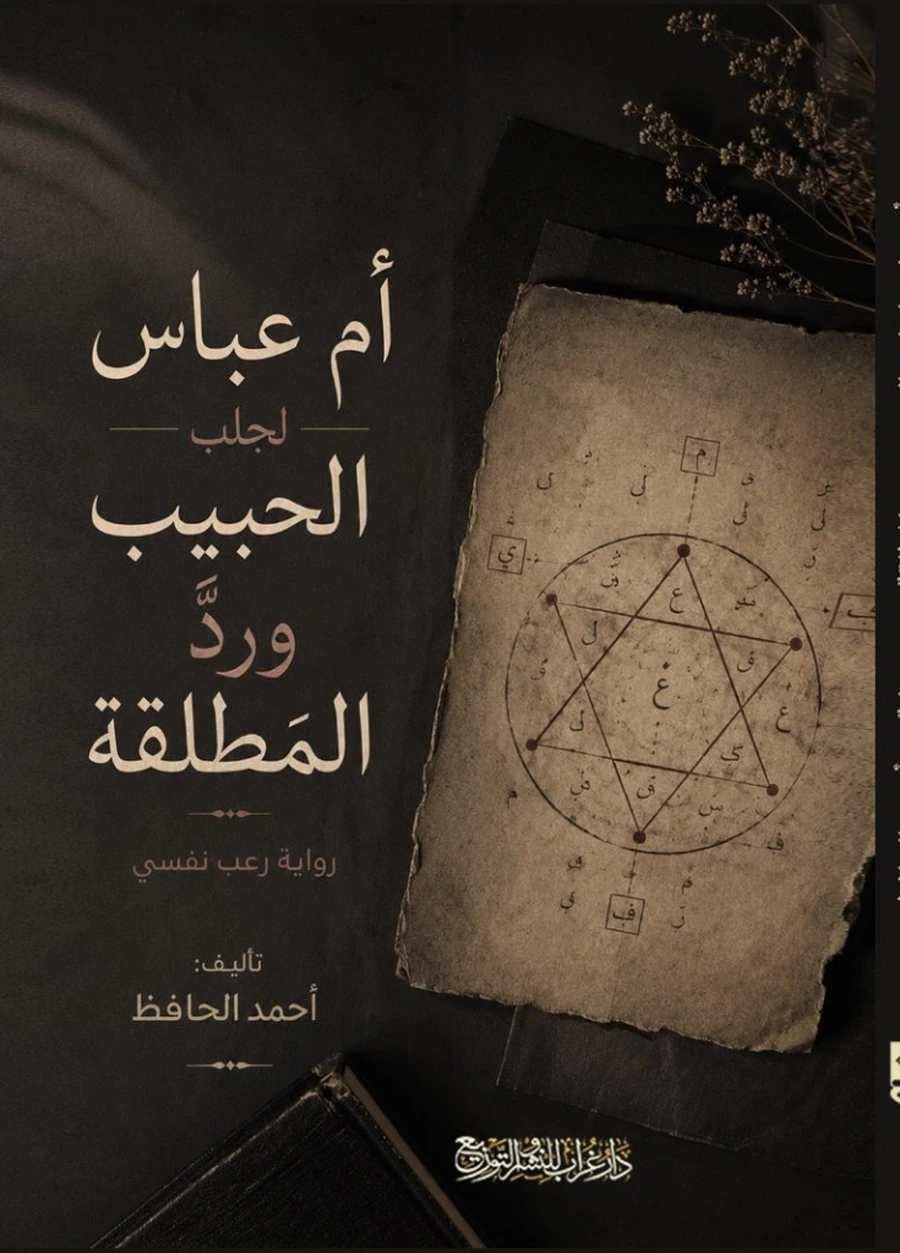
Umm Abbas: Bringing the Beloved and Reuniting a Divorced Woman with Her Husband
A forthcoming psychological horror novel by Ahmed Alhafiz. Promises of bringing back someone who has gone, and the question of fear and authority in Maryam's world.
Explore the novelAlhafiz, Ahmed. "Attracting the Beloved and Reuniting a Divorced Woman: Does Love Magic Work, and What Is the Ruling on It?" 27 October 2026. https://ahmedalhafiz.com/articles/love-magic-reconciliation-ruling/