
Short answer
The Quran affirms jinn’s existence and distinguishes the righteous among them; the Gospels recount the expulsion of unclean spirits; Deuteronomy mentions demons in rejecting their worship. These texts do not make their concepts identical or supply a symptom checklist for diagnosing an individual. This compares the meanings of selected passages, rather than every detail of all three traditions.[1][2][9][10][12]
This is general educational material by the author, not a medical diagnosis or a religious ruling for an individual case. Independent external medical and religious specialist review has not yet been conducted. Do not stop prescribed treatment on your own.
Existence and diagnosis are different questions
A reader may search “Are demons real?” and find horror stories and symptom lists. Before moving from belief to an explanation of illness, however, we should read the texts themselves: what do they say, what do they address, and do they use the same concept?
In Islam, jinn’s existence is established by the Quranic text. The Gospels contain accounts of unclean spirits and the expulsion of demons. Deuteronomy mentions beings translated as “demons” in a context rejecting worship of anything other than God. These religious sources have different contexts; their convergence cannot become a medical test diagnosing a particular person.
This distinction illuminates Umm Abbas li-Jalb al-Habib wa-Radd al-Mutallaqa. Competing explanations surround Maryam, while asking why she suffers sometimes displaces concern for her safety. Reading the texts in context helps us understand religion’s presence in the novel without treating its imagined events as experimental evidence of possession.
How can we compare without confusing sources?
Distinguish a religious text, its interpretation within its tradition and our inference from comparison. A verse is not a commentator’s words; Mark’s Gospel is not later Catholic teaching; Rashi’s commentary is not part of the Torah’s wording. Translation also chooses words to approximate meaning, without guaranteeing that terms in different languages share every property.
Here “Gospels” means the received New Testament texts, focusing on Mark; “Torah” means the five books of Moses. This defines what we read without settling questions of revelation or the books’ composition history. Comparison begins with a more precise question than collecting references: what does each passage establish in its context?
The Quran: not all jinn are demons
In Al-Jinn 72:1, God says: “Say: it was revealed to me that a group of jinn listened.” The passage describes beings who hear the Quran and speak about it. Verse 72:11 distinguishes them: “Among us are the righteous, and among us are those otherwise.” “Jinn” and “demons” therefore cannot be treated as interchangeable names for every member of the category.
Al-Kahf 18:50 says of Iblis: “He was of the jinn, and departed from his Lord’s command.” This identifies Iblis’s origin and disobedience without assigning the same judgment to every jinni. The distinction matters because popular imagination tends to collapse all unseen beings into one frightening image.
Al-An‘am 6:112 mentions “demons among humans and jinn”; Ibn Kathir explains that humans also have demons among them. Here the term is not confined to an unseen being: the context describes hostility and misleading speech. We must identify the word and passage before interchanging “jinn” and “demons.” The verse and its interpretation are used here without independently transmitting or authenticating the commentary’s hadith chains.
For a Muslim reader, these verses plainly support belief in jinn’s existence. But they do not answer “Does a jinni cause this seizure or this voice?” merely because a symptom resembles circulated stories. Moving from a general tenet to a judgment about an individual requires independent evidence.
Seeking refuge and fear: a closer reading of 72:6
Verse 72:6 describes human men seeking refuge with men of the jinn and an increase in rahaq. Ibn Kathir explains the practice of appealing to a valley’s jinn master and discusses increased fear. Al-Tabari transmits several readings of rahaq and favors one concerning increased sin among the jinn because humans sought refuge with them.
These interpretive differences cannot be erased by “jinn cause mental illness.” Fear, sin and aggression in commentary are not modern diagnostic categories. The value lies in understanding misguided refuge, fear and reliance on a power sought for protection, while keeping commentators’ words in context.
This connects directly with the novel: the dark marginal note on pages 202–203 invokes the verse, while the story shows seeking safety becoming dependency and fear. This is literary analysis of text and narrative, rather than proof that Maryam is a documented human case of jinn’s effects.
Did Islamic tradition discuss possession?
Yes. In his commentary on Al-Baqarah 2:275, Al-Qurtubi affirms the possibility of jinn’s effects and possession in his reading. It is inaccurate to portray all commentators as denying it or treating it as metaphor alone. The verse nevertheless concerns usury, and religious interpretation supplies no clinical checklist distinguishing every seizure or disorder from possession.
The report in Sahih al-Bukhari 2038 about Satan moving like blood concerns the Prophet explaining Safiyya’s identity to two men to prevent suspicion. Preserving its setting prevents presenting it as an anatomical account of neurological illness.
The command to seek treatment appears in Sunan Abi Dawud 3855, whose source displays Al-Albani’s authentic grading. A Muslim need not abandon medical treatment to respect belief in the unseen. A religious argument does not become stronger by assigning medical details to a text that never explained them.
Does Satan’s influence remove human responsibility?
In Ibrahim 14:22, the Quran recounts Satan’s invitation and his followers’ response. Al-Sa‘di explains the denied authority as authority through argument and evidence, distinguishing it from influence through temptation toward sin.[15] We therefore neither reduce the passage to denial of every satanic influence nor derive a neurological explanation of bodily movement. Its question concerns invitation, response and accountability in the Hereafter.
This precision prevents using “control” identically everywhere. Moving from a discourse of accountability to accusing someone with symptoms of choosing their illness is unsupported; the verse does not judge Maryam or an individual patient. Reading the novel requires distinguishing a person’s actions, what is attributed to them and others’ explanations, without turning suffering into a moral accusation.
The Gospel: accounts of expelling unclean spirits
Mark 5:1–20 recounts a man suffering from an unclean spirit and ends with his restoration and the spirits’ departure. In Mark 9:14–29, a father describes his son’s falling, rigidity and foaming; the text recounts the spirit’s expulsion and the boy’s rising. Within Christianity’s framework, these narratives concern Jesus’s authority over unclean spirits.
Resemblance between outward descriptions and symptoms known today permits neither retrospectively diagnosing an ancient person nor establishing the same cause in everyone with similar symptoms. A religious text is not a contemporary examination report.
A textual qualification must be preserved: the US Conference of Catholic Bishops’ published edition notes that some manuscripts add fasting to prayer in Mark 9:29. “Prayer and fasting” therefore should not be presented as identical wording in every textual version.
Does the Gospel attribute every illness to a demon?
Mark 1:29–34 mentions Simon’s mother-in-law’s fever, then describes healing the sick and expelling demons separately. Within the narrative, illness is therefore not always equated with spirits. This supplies no modern medical criteria and does not settle the cause of a present-day reader’s symptoms.
“Are there jinn in Christianity?” needs precision: the selected passages address unclean spirits and demons. We can present them within their religious belief without automatically replacing their terms with jinn in every Quranic detail. Similar narrative roles justify comparison without establishing identical concepts.
In Mark 5:19–20, Jesus instructs the man to go to his family and tell them what happened; the narrative then recounts his proclamation in the Decapolis.[9] Return to family and community appears alongside the spirits’ expulsion. This human dimension helps us read Maryam: what happens to her relationship with home and others when suffering becomes an accusation? This is a proposed literary connection, rather than an equation of the novel’s character with the Gospel’s figure.
What does the Catholic Church say about illness?
The Catechism of the Catholic Church, paragraph 1673, recognizes exorcism and limits its solemn form to specified ecclesial authority. It also emphasizes distinguishing possession from illness, especially psychological illness whose treatment belongs to medicine.
This official source combines religious belief with caution about confusion. It represents the stated Catholic teaching; its details cannot automatically be attributed to every Christian denomination. A religious procedure’s existence also does not make it a validated medical test for symptoms’ causes.
The Torah: Deuteronomy 32:17 and worship
Deuteronomy 32:17 at Chabad includes שדים, translated as “demons.” Verses 15–18 concern turning from God and foreign worship. The translation describes these beings as powerless; Rashi explains that reading.[12]
For comparison, USCCB’s translation of the same passage uses “no-gods,” meaning beings that are not gods.[16] This differs from Chabad’s expression about power. We do not treat two English translations as one Hebrew wording or an identical judgment. The clear point in the selected context is condemnation of worshiping these beings. This compares published translations without independently adjudicating the Hebrew original.
The term appears in a context of worship, rather than diagnosing bodily possession or establishing equivalence with Quranic jinn.
Rashi’s commentary is interpretation, rather than the verse’s words. Here Torah means the five books of Moses, distinguished from the Talmud and other Hebrew biblical books.
The passage supplies no mechanism producing illness or affecting the body. This reading is limited to the text, rather than a survey of every Jewish view of the unseen.
A comparison that preserves differences
| Passage | What supports the argument here | The limit we do not exceed |
|---|---|---|
| The Quran: Al-Jinn 1 and 11, Al-Kahf 50 | Jinn’s existence and diversity, and Iblis’s origin | Does not establish an individual symptom’s cause |
| The Quran: Al-Jinn 6 and its commentary | Refuge with jinn and rahaq, with differing interpretations | Rahaq is not automatically translated into mental illness |
| Ibrahim 22 and Al-Sa‘di’s commentary | Invitation, response, authority through argument and temptation | Yields neither diagnosis nor accusation against a patient |
| Mark 5 and 9 | Accounts of expelling unclean spirits in Christian faith | Not contemporary medical reports |
| Mark 1:29–34 | Illness and expelling demons mentioned separately | Defines no medical criterion diagnosing the reader |
| Deuteronomy 32:17 | Demons mentioned in condemning foreign worship | Not a description diagnosing bodily possession |
| Catholic Catechism 1673 | A religious procedure distinguished from illness | Represents neither all denominations nor a clinical test |
How does this strengthen a reading of Umm Abbas?
On pages 194 and 200, Sheikh Ahmed’s position within the story keeps the doctor involved and prevents the family’s question from distracting them from Maryam. This matters in comparison with Al-Surani, who turns explanation into authority and coercion.
The construction’s strength is not that the novel settles what medicine has not settled or makes every interpretation true. Its literary force, in this reading, lies in asking how a claimed helper behaves: do they protect dignity, accept their knowledge’s limits and keep treatment available?
Pages 202–203 give the comparison its clear Islamic center: fear, misguided appeals for help and household division appear in the marginal note and story. We return to Al-Jinn 6’s commentary to understand rahaq, then distinguish it from diagnosing Maryam. The texts become tools for reading the novel’s question.
The dark marginal note on pages 184–185 likewise emphasizes that a scene alone cannot prove possession. This can coexist with the doctrinal texts: affirming jinn’s existence in Islam does not require believing every possession accusation.
The report of separating spouses: why does the household become part of the horror?
The marginal note on page 203 invokes a Sahih Muslim report about Iblis and his detachments, and his favoring one who says he separated a man from his wife.[17] Its subject is discord and marital separation. We do not expand its wording to attribute every family disagreement or psychological disorder to a diagnosed satanic act.
Its literary function is specific: fear does not remain inside Maryam’s head; it enters her parents’ relationship and how they treat their daughter. On page 194, Sheikh Ahmed rejects making Maryam their battlefield; on page 200, he rejects turning fear into a sale. The report and marginal note let us read household division as a central question, while distinguishing the marital relationship in the hadith from the family network built by the narrative.
Sheikh Ahmed thus differs from Al-Surani in action before interpretation: continuing the doctor’s involvement, rejecting seclusion, touch and payment in the fictional situation, and protecting Maryam from the conflict around her. These textual indicators concern the ethics of helping within the story; they neither endorse a real practitioner nor guarantee a treatment’s effectiveness.
Does studying strange experiences prove jinn?
The US National Institute of Mental Health explains that psychosis is a group of symptoms that may include hearing voices, without one single cause. It lists factors and possibilities including certain illnesses, sleep deprivation, medications and substances, and emphasizes professional assessment and the person’s participation in care decisions.[18] This is clinical education, rather than an experiment proving possession or diagnosing Maryam.
Separate three questions: did the experience occur, what medically supported explanation concerns it, and what does the religious text being compared mean? An honest account of hearing a voice does not alone establish its source. Resemblance to an old description does not establish an identical cause; inability to explain an event now likewise does not prove a particular explanation.
This distinction helps us read pages 184–185: the narrative conveys Maryam’s experience and the marginal note suggests possibilities, while real diagnosis remains beyond a fictional scene. Obsession, hallucination and dissociation are not equivalent simply because “voice” appears; each description has conditions and context. The published hearing-voices article develops these differences.
Nor should an atheist identity be assigned to a researcher who has not declared it, or replace analysis of their work. Religious support chosen by the person does not justify stopping prescribed treatment or coercion. Persistent or worsening symptoms call for medical assessment; immediate danger to safety calls for local emergency services. This comparison supplies neither treatment nor a possession test.[18]
Frequently asked questions
Do the three texts establish “jinn” in the same sense? The selected passages permit comparison but use different terms and contexts. Establish what each says before asserting equivalence.
Does resemblance between convulsions or hearing voices and a religious description prove possession? Similar description does not settle an individual case’s cause. The article explains texts’ meanings without diagnosing symptoms.
Does affirming jinn’s existence in Islam require abandoning the doctor? The stated hadith commands seeking treatment; general verses do not become individual diagnoses. Sheikh Ahmed keeps the doctor involved in the novel.[8]
Further reading: Umm Abbas, Do Jinn Exist? Evidence from the Quran and Sunnah, Possession or a Neurological or Psychological Disorder?, and Exploitation in the Name of Spiritual Healing.
For particular experiences: Hearing Voices in the Head and Memory Gaps and Unremembered Actions. Each article has its own question; literary connections do not replace medical assessment.
Sources and reading scope
- Source 1: The Quran, Al-Jinn 72:1; Ibn Kathir’s commentary at King Saud University; the passage was read.
- Source 2: The Quran, Al-Jinn 72:11; Ibn Kathir’s commentary on jinn’s diversity.
- Source 3: The Quran, Al-Kahf 18:50; Ibn Kathir’s commentary on Iblis’s origin.
- Source 4: The Quran, Al-Jinn 72:6; Ibn Kathir’s passage on refuge and rahaq was read.
- Source 5: Al-Tabari’s commentary on Al-Jinn 72:6; the differing readings of rahaq and his preference were read.
- Source 6: Al-Qurtubi’s commentary on Al-Baqarah 2:275; the possession-related questions and context were read, rather than every question concerning usury.
- Source 7: Sahih al-Bukhari 2038; the report and Safiyya context were read.
- Source 8: Sunan Abi Dawud 3855; the text and displayed Al-Albani grading were read, without independently investigating transmission chains.
- Source 9: Mark 5 at USCCB; the chapter and notes were read. It commands going to family and recounts proclamation in the Decapolis; the Arabic article summarizes the meaning.
- Source 10: Mark 9 at USCCB; the chapter and notes were read, including manuscript variation at 9:29. Not all books linked in its notes were read.
- Source 11: Catholic Catechism 1673, Vatican website; the complete paragraph was read, without generalizing to every denomination.
- Source 12: Deuteronomy 32 at Chabad; verses 15–18, their translation and the relevant Rashi commentary were read. Neither the entire chapter and its commentaries nor an independent Hebrew linguistic investigation was undertaken.
- Source 13: Mark 1 at USCCB; the chapter and notes were read; 1:29–34 mentions illness and expelling demons separately.
- Source 14: The Quran, Al-An‘am 6:112; the verse and Ibn Kathir’s commentary were read. Its hadith reports are not presented as independently investigated chains.
- Source 15: The Quran, Ibrahim 14:22; the verse and complete Al-Sa‘di commentary were read, distinguishing argumentative authority from temptation.
- Source 16: Deuteronomy 32 at USCCB; verses 15–18 and their setting were read to compare translations. No claim of reading every note or adjudicating the Hebrew original.
- Source 17: Sahih Muslim 2813b; Jabir’s report concerning Iblis, his detachments and separation of spouses; the complete text was read.
- Source 18: NIMH, Understanding Psychosis, NIH Publication No. 23-MH-8110; the complete educational publication was read. An official clinical educational source, rather than an experiment proving possession; not all studies it links were read.
Novel passages follow manuscript pagination: the dark marginal note on pages 184–185; Sheikh Ahmed’s position on pages 194 and 200; the religious marginal note on pages 202–203. The manuscript starts the question and literary reading, rather than a documented clinical case. Pagination may change in the final edition.
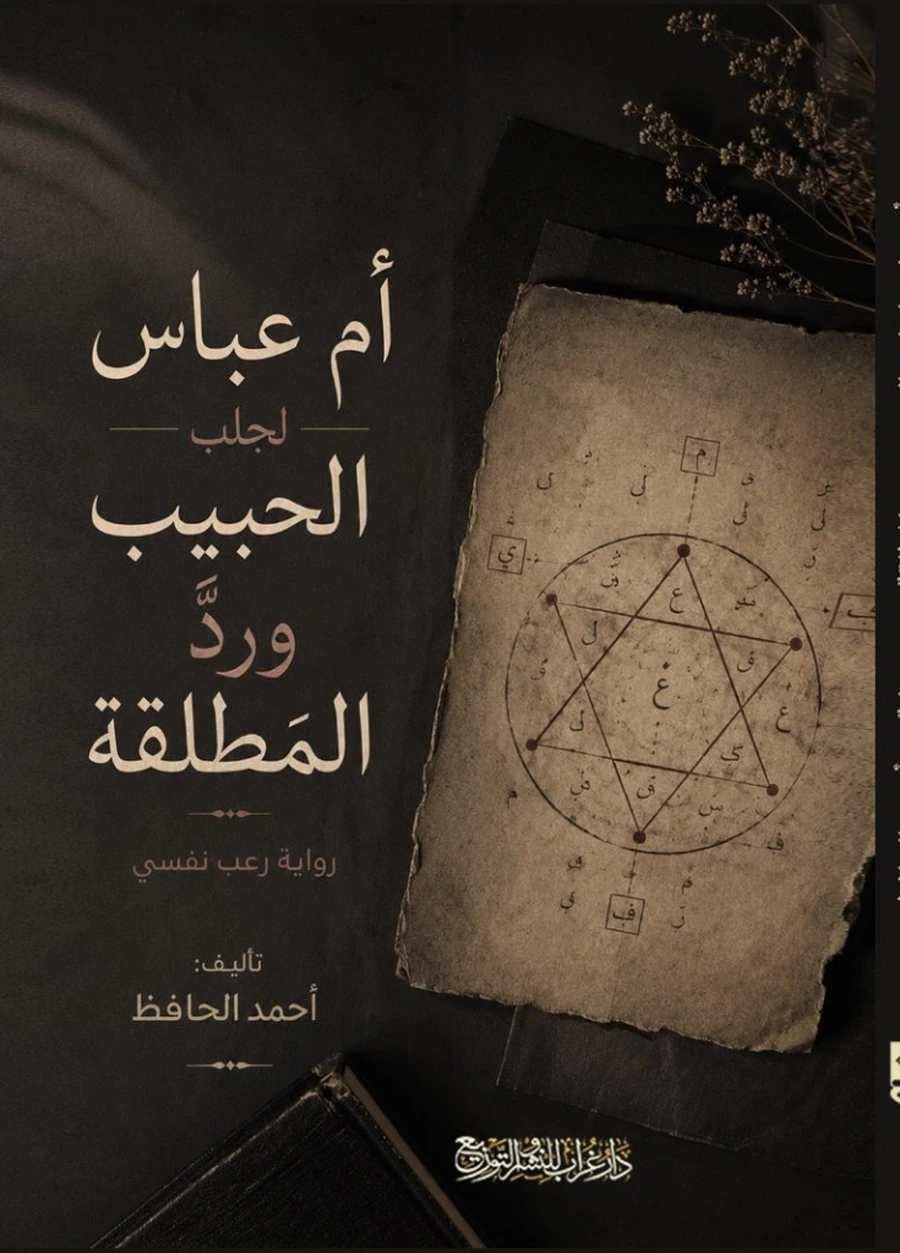
Umm Abbas li-Jalb al-Habib wa-Radd al-Mutallaqa
A psychological horror novel by Ahmed Alhafiz, forthcoming. Discover its world and status, then read the related dossiers according to your question.
Discover the novelRead about jinn and the limits of inferenceAlhafiz, Ahmed. “Jinn and Demons in the Quran, Gospel and Torah: Do They Mean the Same Thing?” 1 October 2026. https://ahmedalhafiz.com/en/articles/jinn-demons-quran-bible-torah/