
Short answer
The six-pointed star is a shape used on objects with different functions. Its presence alone does not prove witchcraft, the age of a paper, or its owner’s beliefs. “Seal of Solomon” is a historical name for some uses, while the Quranic verses about Solomon do not describe a six-pointed seal.
In the novel «أم عباس», Maryam copies a drawing from a video and then adds letters she could not read. We therefore need to distinguish the paper in the video from her copy and from what the narrator claims about each. Explore the novel.
On printed pages 4–5 of the novel «أم عباس لجلب الحبيب ورد المطلقة» (Umm Abbas), Maryam watches a video promoting an “ancient magic talisman.” It shows a worn sheet bearing a six-pointed star resembling the Star of David, an incomplete circle, squares and scattered Arabic letters. Maryam does not begin by believing the person in the video: she mocks his tone, then pauses at the drawing’s order. On pages 9–10 she copies it into a notebook, invents some letters because she cannot read them, and calls the drawing “Umm Abbas — the university version.” This is where the article’s question begins: What does a symbol’s shape establish, and what changes when someone copies it or gives it a name and a story?
From an unknown video to a copy in Maryam’s notebook
The fictional scene has four layers to keep separate. What is seen: a six-pointed star, circle, squares and letters difficult to read on a video screen. The video maker’s claim: he calls it a talisman and warns against repeating it. Maryam’s action: she makes an imperfect copy, adds dots and letters of her own, and photographs it. The external judgment: is the paper in the video an old artifact, and what was it made for? The first three layers do not answer the fourth. Moreover, the notebook page is recent and partly invented within the novel, so its letters cannot be used as evidence for those on the alleged original.
When someone places a picture of the notebook beside an image from the video, they can examine a simple chain of changes: a source of unknown date, a shot selected by the video maker, Maryam’s drawing from an unclear screen, and then a photograph of her drawing with a joking name. Every transfer loses details or adds new ones. This neither proves nor disproves the talisman’s efficacy within the novel’s world. It does show why the chain of source and copies comes before interpreting the star when the question concerns the origin of a particular paper.
To study a real sheet, a researcher would ask where it was found, whether its ownership history is documented, what its material, ink and handwriting are, whether its words can be read instead of assumed to be sacred text or a magical formula, and whether it shows signs of use, such as folding, hanging or sealing. A cropped image in a short video reveals neither the back of the paper nor its date or physical layers. Its yellowing might be old, recent, or a visual effect. This is a method for reading a document, not an attempt to diagnose Maryam or instructions for handling charms.
An eleventh-century amuletic scroll in the Metropolitan Museum illustrates what can be said when an object is preserved and catalogued. The museum identifies its paper, printing, writing style and contents combining prayers, charms and Quranic verses, and explains that the six-pointed star is often called the “Seal of Solomon” in Islamic art. Documenting a symbol’s historical use does not prove an amulet’s efficacy; it establishes that people made objects and attributed a function to them. Nor does it make every paper bearing the shape a copy of this scroll.
Three historical objects, a similar shape and different meanings
The first object is that scroll: its context is amuletic, and “Seal of Solomon” is a museum curator’s description of a symbol in this tradition. A gold earring from Iraq, probably dated to the eleventh through thirteenth centuries, bears a six-pointed star that the museum says perhaps alludes to Solomon’s seal as a protective symbol. “Perhaps” matters: the earring is a physical ornament, while an account of the original motive behind its decoration is a historical inference, not direct testimony from its maker. A star on jewelry does not automatically tell us what its wearer believed.
The second object is a fourteenth-century German lamp at the Jewish Museum. Similar lamps were used in European homes and later retained a ritual use in some Jewish homes. A Star of David is engraved on the underside of part of the lamp, but the museum explicitly says this does not by itself establish Jewish ownership in that century. The common shortcut, “I saw the symbol, so I know who owned the object,” fails here. That does not, in turn, justify denying that the star became a clear Jewish symbol in later and present-day contexts.
The third object is a silver seal attributed to eighteenth-century Turkey. Within the star are the names of the Rightly Guided Caliphs and the Prophet ﷺ; the museum also describes the names of the Companions of the Cave and the dog Qitmir in a protective meaning attributed to the object. This shows how accompanying text, shape and date can support a reading different from another object bearing the same star. A museum description is not scientific confirmation of supernatural protection, and we must not read the illegible letters on Maryam’s paper as though they were these names.
A Jewish Museum discussion of its collections also shows the star in expressions of Jewish identity and in secular decoration, including a European pitcher associated with tavern signs. The choice is therefore not between two absolute statements, “it is always magic” and “it is always just decoration.” Rather, the function of a drawing must be studied on the specific object and in its context; its religious or social meaning today must not be erased on account of an earlier, different use.
It would likewise be a mistake to seek the “first person to invent the star” from these objects alone. The scroll, earring, lamp and seal are evidence from different places and times; they do not form a continuous chain of transmission from one maker to another. The date of an exhibited object shows that the shape existed then or earlier, not when it first appeared anywhere in the world. Even two similar stars cannot tell us whether the second maker copied the first or independently arrived at the same geometric drawing. A claim of transmission needs narrower evidence: documents, routes of circulation and texts that name the symbol in their own time, not just two similar designs.
Notice, too, the differences in the catalogue language: the scroll is dated to the eleventh century, the earring is probably dated between two centuries, and the silver seal is attributed geographically to Turkey. These are not interchangeable words of certainty. Some describe an existing material object; others are estimates based on comparison. Respecting such qualifiers lets readers see how much is actually known. This is what Maryam’s video lacks: it gives no findspot or custody history for the paper, yet offers a final answer before the first question has been asked.
Can old amulets contain squares and letters?
Yes. The University of Michigan documents a twentieth-century lead amulet from Cairo. On its front, the names of the Companions of the Cave form intersecting words making a six-pointed star; on its back is a five-by-five square containing pairs of letters, some variations of the disconnected letters that open certain Quranic chapters. This is one specific object combining a star, letters and a square. Its form need not match the paper in the novel’s video, nor does it prove the drawing was transmitted from one to the other. The novel adds a still narrower limit: Maryam invented letters in her copy because the source image was unreadable, so we cannot even assume the letters in the two drawings are alike. When an inscription cannot be read, we record it as unreadable instead of completing it from imagination.
The distinction between describing a historical function and accepting a claim of efficacy is essential. A museum may call something an “amulet” because its maker or user carried it for protection, just as it classifies a weapon or tool by its material traces and documented use. This does not put an instrument for measuring an unseen effect in a curator’s hands. An object may bear religious writing in a devotional context, a protective context, or a use later reinterpreted. No single label replaces a close reading of text, function and date.
“Seal of Solomon” as a historical name and in Quranic text
Surah al-Naml 27:17 tells of Solomon’s assembled forces of jinn, humans and birds, while Surah Saba 34:12 mentions some jinn working before him by God’s permission. Al-Baqarah 2:102 expressly denies that Solomon disbelieved and attributes the teaching of magic to devils; al-Tabari explains the context of clearing him of the charge of magic. These verses do not describe a drawing on his seal or mention a six-pointed star. A museum object’s name therefore cannot be turned into a Quranic statement establishing the shape’s origin or conferring power on it.
It is legitimate to describe the use of the name “Seal of Solomon” as it appears in the history of art and amulets, attributing the description to the culture that made the object. It is also legitimate to read the religious verse clearing Solomon of the charge in its own domain. But the sentence “this star is the seal by which Solomon ruled the jinn according to the Quran” combines a popular story, a museum drawing and verses that do not specify that drawing. Here a religious writer needs precision of wording, not greater certainty.
A historical object said to bear “Solomon’s name” calls for the same care. The name may be written in an inscription; a museum may classify a symbol as the “Seal of Solomon”; and a popular tale may speak of a powerful ring. These are three kinds of report. A legible inscription proves that a name was written, the museum’s designation describes a historical term, and the story records a narrator’s belief. None of these together testifies that the object actually belonged to the prophet Solomon. Conversely, rejecting the attribution of a tale to him does not erase the object or the history of its use.
This distinction does not license mocking someone frightened by a strange paper, or treating that fear as evidence that magic occurred. Nor does it justify associating the Star of David with Jews and then accusing Jews as a group of magic; that is a historical confusion and a human harm. Religious rulings on wearing and using amulets involve detailed questions and differences beyond this historical article. One cannot infer a ruling about a person or object by counting the points of a star.
Why does the paper work in the novel even when its origin is unknown?
The video maker gives the paper a name and an alleged history before Maryam can examine it. The eye receives a relatively familiar mark, letters that form no clear sentence, and an arrangement of geometric order alongside linguistic disorder. Maryam then copies what she saw and fills the gaps; the drawing becomes something she made with her own hand, not just a picture she watched. In the story, dread emerges because the form looks purposeful while its purpose remains unknown. This describes the construction of a fictional scene, not a scientific experiment proving an effect from seeing or copying the symbol. Why events happen to Maryam remains a question for the story’s world, not for a different archaeological object.
The difference between museum and video is part of the plot of «أم عباس». A museum offers an approximate date, material, place of custody and cautious language such as “perhaps.” The video offers a person claiming a decisive meaning and immediate danger, before Maryam adds things she could not clearly see to her copy. Pausing to look is not her mistake; the problem of knowledge begins when an incomplete copy is turned into evidence for an unknown original. The novel thus also asks how a story forms around an image and how that image changes as it travels.
A reader may ask: “If I find a similar drawing, should I throw it away?” A historical article cannot issue a religious ruling about the ownership, religious status or safety of an object it has not seen. It can suggest an epistemic step: do not copy the paper or post an image belonging to someone else to obtain a quick interpretation; preserve its context, consult a trusted authority if there is a threat or exploitation, and ask a manuscript specialist if the aim is genuinely to identify a physical artifact. If the fear itself is severe or persistent, seeking support does not require proof that the symbol has power.
Quick questions
Is every six-pointed star a Star of David? The geometric form appears in many settings, while “Star of David” is a name and an identity in particular Jewish contexts. An object’s date, location and text help determine which term describes it; the shape alone does not identify its owner.
Is everything called the Seal of Solomon magic? In museum catalogues, the name may describe decoration, an amulet, or a legendary tradition associated with a symbol. The name alone cannot establish someone’s act, an object’s efficacy, or a religious ruling on it.
Does the Quran mention the six-pointed star? The verses about Solomon’s rule, the jinn working for him, and his innocence of magic do not specify a six-pointed seal. Do not attribute to the text a detail it does not state.
Is a photograph enough to establish that a paper is ancient? No. The physical original, its transmission history and its writing must be studied. Maryam sees the paper through a video in a novel, so the possibility that the image was manufactured remains a limit on what can be known within the scene.
Sources and review limits
- Ahmed Alhafiz, «أم عباس لجلب الحبيب ورد المطلقة», final manuscript supplied by the author, printed pages 4–5 and 9–10. A source only for the literary scene; the private manuscript is not published here.
- Metropolitan Museum of Art, eleventh-century amuletic scroll, accession 1978.546.32: physical document and museum description, not evidence of supernatural effect.
- Metropolitan Museum, gold earring from Iraq, accession 95.16.3: probable dating and possible protective significance, without turning possibility into certainty.
- Jewish Museum, fourteenth-century lamp, JM 200-67: the star’s form on the object does not suffice to establish its original owner.
- Metropolitan Museum, eighteenth-century silver seal, accession 1983.135.11: inscription, names and a specific documented context.
- Jewish Museum, “Signs and Symbols” exhibition: examples of varied identity-related and secular uses, not a complete history of the symbol’s origin.
- University of Michigan Kelsey Museum, Cairo amulet, accession 80681: evidence of a star, square and letters on one twentieth-century object, not an explanation of Maryam’s paper.
- Al-Tabari, commentary on al-Baqarah 2:102, al-Naml 27:17, and Saba 34:12: the limits of what the text says about Solomon, without attributing a seal shape to him.
Review status: Internal editorial and source review. No independent review by a historian of Islamic art, a specialist in Jewish history, or a Quranic exegete has yet been completed. Dates and attributions follow the institutions’ catalogues and may change with new research. This is a historical article and literary reading, not a fatwa or a guide to proving magic or denying a person’s experience.
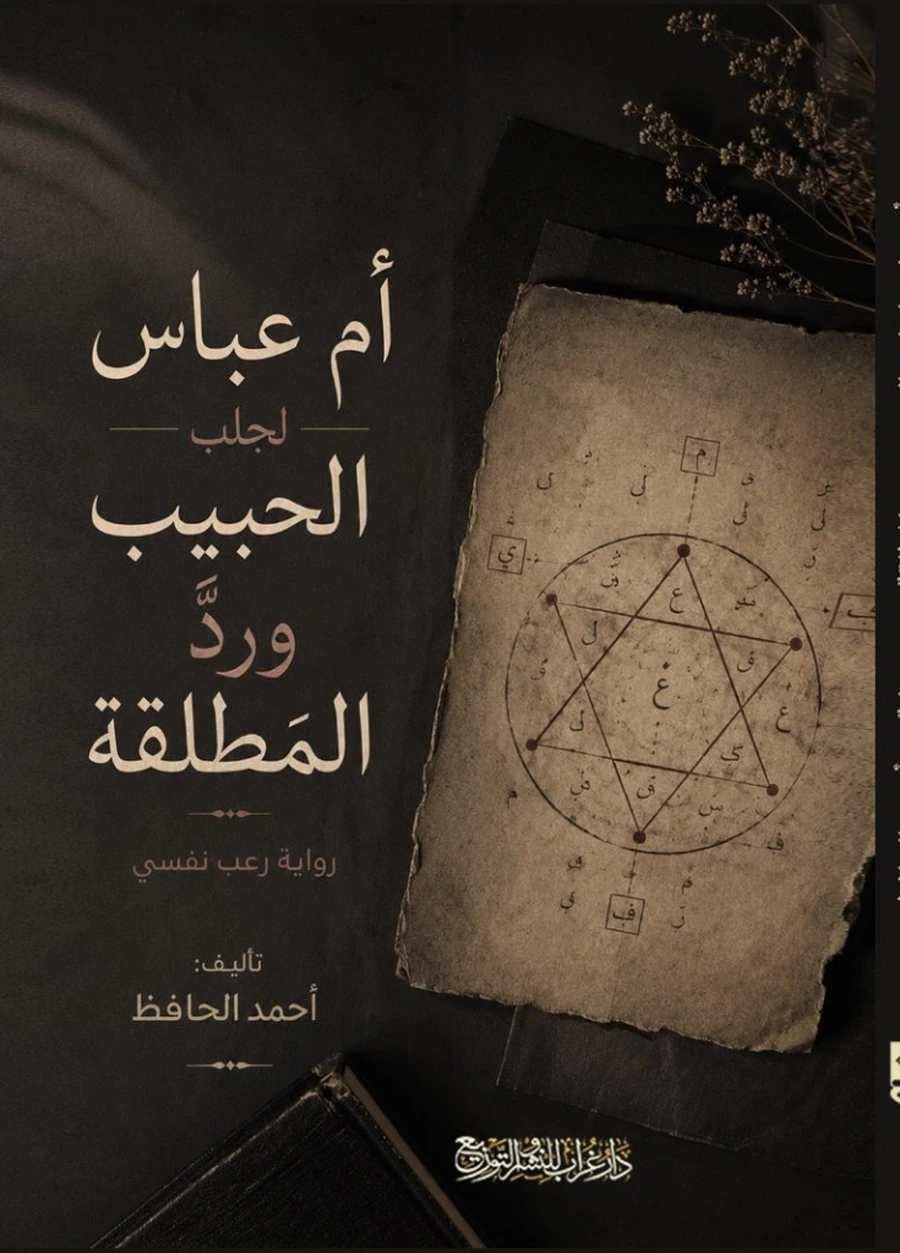
«أم عباس لجلب الحبيب ورد المطلقة»
A forthcoming psychological horror novel by Ahmed Alhafiz. Why does a drawing become more unsettling when Maryam transfers it from a screen to paper by hand?
Explore the novelAlhafiz, Ahmed. “Does a Six-Pointed Star Mean Witchcraft? What Is the Seal of Solomon?” 2 October 2026. https://ahmedalhafiz.com/en/articles/hexagram-magic-seal-of-solomon-umm-abbas/